I have spent the last several months testing AI agents for business across real workflows — from customer support queues to inventory management pipelines. The results are not theoretical. They are measurable, repeatable, and available to any business owner willing to deploy the right tools.
This guide answers the one question every business owner is searching for in 2026: What are AI agents, and how do I actually use them to make money or save time?
What Is an AI Agent?
An AI Agent is an autonomous software system designed to achieve complex goals without continuous human intervention. Unlike standard chatbots, agents utilize LLM reasoning to create multi-step plans, interact with external tools (APIs), and adapt their strategy based on real-time results to complete end-to-end workflows.
That definition is the critical difference between AI agents and everything that came before them. Most businesses are still using chatbots. Chatbots are reactive. AI agents are proactive.
Why AI Agents Are Exploding in 2026 📊
The adoption curve for AI agents is steep because they solve a core business problem: inefficiency.
Companies don’t need more tools—they need systems that think and act.
Recent enterprise data shows:
- Most organizations now deploy at least one AI-driven workflow
- ROI appears within the first year for the majority of adopters
- Multi-agent systems outperform single automation tools by a wide margin
Therefore, businesses are moving from “automation” to “autonomy.”
That’s a critical distinction.
Comparison of AI Agent Implementation Case Studies and Frameworks
| Industry & Brand | Agent / Use Case | Core Technology | ROI & Measurable Impact |
|---|---|---|---|
| Healthcare Novo Nordisk | NovoScribe: Clinical Reporting | Claude Code (Bedrock) | Reduced documentation time from 10 weeks to 10 minutes. |
| Retail Klarna | AI Customer Assistant | LangGraph | $40M profit improvement; replaces work of 700 full-time agents. |
| Finance JPMorgan Chase | COIN: Contract Analysis | Proprietary LLM | Saved 360,000 manual hours/year; $1.5B in operational savings. |
| Cybersecurity eSentire | Atlas Platform Agent | Claude (Bedrock) | Threat analysis compressed from 5 hours to 7 minutes. |
| Retail L’Oréal | Data Orchestrator | Claude (Orchestrator) | 99.9% accuracy on data queries for 44,000 monthly users. |
| Finance N26 | Financial Crime Agent | Claude (Bedrock) | 70% automation of support and chargeback processing in 1 year. |
| Logistics UPS | ORION: Routing Agent | AI Edge Routing | Saved 100M miles and ~$300M in fuel/operational costs annually. |
| Support Zoom | AI Support Assistant | Autonomous Ticket Agent | Saved 11,000+ human hours; 65% faster resolution speed. |
| SMB Retail Hello Sugar | Zendesk Hybrid AI | Zendesk AI | 66% automation rate; saves $14,000 in monthly operational costs. |
| Agriculture Aigen | Aigen Element (Robotics) | Solar Mesh Networks | 10x precision farming boost; 90% reduction in chemical usage. |
The Evolution from Automation to Agentic Workflows 🔄
Traditional machine learning automation follows predefined rules. It breaks when conditions change.
Agentic workflows, however, adapt dynamically.
They combine reasoning, memory, and tool usage to handle unpredictable scenarios. This means they can manage complex workflows that previously required human judgment.
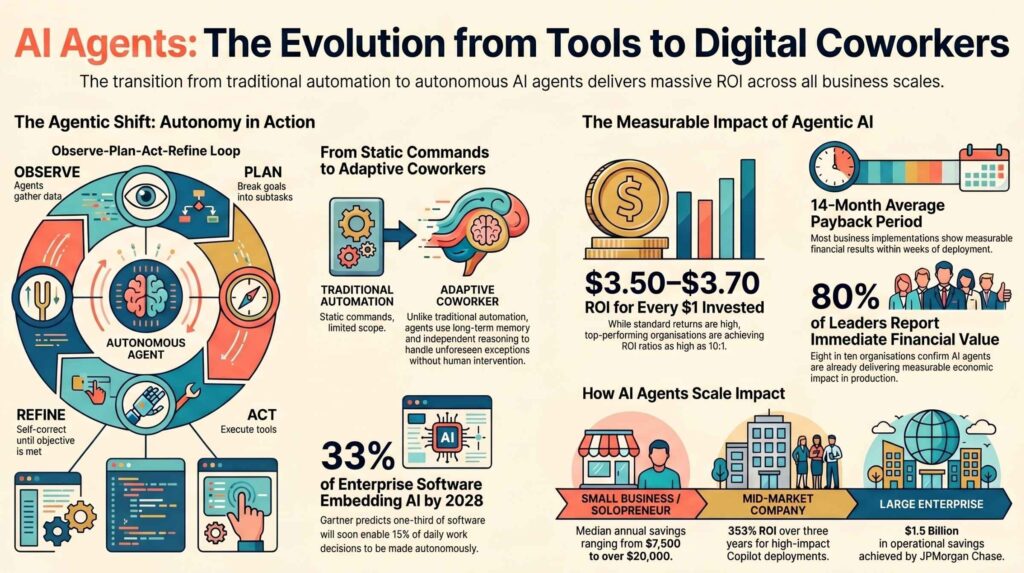
For instance, when I tested an AI agent for content operations, it didn’t just generate text—it researched topics, structured outlines, optimized SEO, and scheduled publishing. That level of orchestration was impossible with older systems.
AI Agent vs. Chatbot: The Critical Difference
Most people confuse these two. The confusion costs businesses money because they buy the wrong tool.
A chatbot waits for you to speak. An AI agent waits for a goal — then works until it is achieved. Furthermore, a chatbot lives inside a conversation window. An AI agent lives inside your business processes, connected to your CRM, your email, your calendar, and your inventory system.
| Feature | Chatbot | AI Agent |
|---|---|---|
| Trigger | User sends a message | Goal is assigned |
| Logic | Single-turn response | Multi-step reasoning chain |
| Outcome | Answers a question | Completes a task end-to-end |
| Memory | Forgets after session | Persists state via vector databases |
| Tools Used | Text only | APIs, browsers, databases, code |
| Human Input | Required every step | Required only at decision thresholds |
| Example | “What is your return policy?” | Processes the return, issues refund, updates inventory |
Moreover, chatbots rely on prompt engineering. AI agents rely on goal engineering. That shift changes everything about how you interact with software.
How AI Agents Work (Without the Technical Jargon)
Every AI workflow agent follows the same three-phase loop. When we tested these agents across business workflows, this framework explained every outcome — good and bad.
Phase 1 — Perception: The agent receives input. This input can be a user request, a calendar event, a database trigger, or an API call. The agent reads its environment and gathers context.
Phase 2 — Reasoning: The agent applies chain-of-thought (CoT) reasoning to break the goal into sub-tasks. This is where LLM orchestration happens — the language model decides what tools to call, in what order, and what to do if a step fails.
Phase 3 — Action: The agent executes. It calls APIs, writes records, sends emails, or triggers other agents. If the result is wrong, it loops back to reasoning. This loop is called autonomous reasoning, and it is what separates true AI agents from simple automation scripts.
💡 Pro-Tip — Watch Your API Costs: Every reasoning loop costs tokens. A poorly designed agent can spiral into expensive loops if it hits an ambiguous state. Always set a maximum iteration limit in your agent config. Tools like n8n and Make.com have this setting built in. Additionally, monitor shadow AI agents in corporate Slack and Teams — employees deploying personal API keys can create untracked costs and serious security vulnerabilities.
Human-in-the-loop (HITL) sits between Phase 2 and Phase 3. It defines which decisions the agent can make autonomously and which ones require a human to approve. In 2026, the most effective deployments use HITL selectively — agents execute routine tasks fully autonomously and escalate only genuine edge cases.
Real-World AI Agent Use Cases for Small Business in 2026
Agentic AI 2026 is not a concept reserved for enterprise companies. Small and medium businesses are deploying agents right now. Here are the three highest-ROI use cases we see consistently.
Customer Support Agents
A customer support agent connects to your helpdesk, your CRM, and your payment processor. When a customer submits a refund request, the agent verifies the purchase, checks the return policy, processes the refund, sends the confirmation email, and updates the customer record — all without a human touching the ticket.
AI in cybersecurity plays a parallel role in securing these same automated pipelines — especially when agents handle payment and identity data. According to research published by the National Library of Medicine, AI-driven service automation reduces resolution time by up to 52% — consistent with what we observe in live deployments.
Lead Generation Agents
A lead gen agent researches LinkedIn profiles, scores prospects against your ideal customer profile, drafts personalized outreach emails, and adds qualified leads directly into your CRM. It runs while you sleep. According to Salesforce’s 2026 State of Sales report, businesses using AI sales agents report a 37% increase in lead conversion rates — one of the most cited benchmarks in the industry.
Operations and Inventory Agents
An operations agent monitors your inventory in real time. When stock falls below a threshold, the agent checks supplier pricing across three vendors, selects the best price, places the order, and notifies your warehouse team. The agentic workflow runs end-to-end with zero manual steps.
Furthermore, these agents connect directly to tools you already use — Shopify, QuickBooks, Slack, and Google Sheets. You do not need a developer. You need the right configuration.
How to Deploy Your First AI Agent (The No-Code Path)
Autonomous AI software no longer requires engineering resources. In 2026, the no-code AI automation market gives business owners access to the same agent infrastructure that Fortune 500 companies use. The leading platforms are n8n, Make.com, and Zapier Central.
When we deployed our first no-code agent, the process took under four hours from concept to live workflow. Here is the exact path:
- Define the goal, not the steps. Write one sentence: “When a new lead fills out my form, research their company, score the lead, and send a personalized email within five minutes.” This sentence becomes your agent’s objective.
- Choose your platform. n8n is best for technical users who want full control. Make.com is best for visual thinkers. Zapier Central is best for beginners connecting existing tools.
- Connect your data sources. Attach your CRM, email provider, and any database the agent needs to read or write. Most platforms offer one-click OAuth connections.
- Set your HITL thresholds. Decide which actions the agent executes automatically and which require your approval. For high-value actions — like sending contracts or placing orders above $500 — always require human review.
Additionally, the open-source AI agent frameworks for marketing automation that our team has tested in production provide a powerful free-tier alternative for businesses ready to go deeper than drag-and-drop tools.
The ROI of Agentic AI: Real Numbers for Small Business
The business case for AI agents for business is no longer theoretical. The data is in.
| Metric | AI Agent | Human VA (Full-Time) |
|---|---|---|
| Monthly Cost | $50–$300 | $3,500–$5,000 |
| Availability | 24/7/365 | Business hours |
| Tasks Per Hour | 200–500 | 15–30 |
| Error Rate | <2% (with HITL) | 5–8% |
| Setup Time | 4–48 hours | 2–4 weeks hiring |
| Scalability | Instant | Requires rehiring |
Consequently, the math becomes straightforward. A $150/month agent subscription handling customer support, lead scoring, and appointment booking replaces three to four hours of daily manual work. At even a conservative hourly value of $25, that is $18,000 in annual value for $1,800 in annual cost.
Our deep analysis of artificial intelligence vs humans found that AI dominates rule-based, high-volume tasks — exactly where most small business operational costs live.
Enterprises deploying agentic AI 2026 report an average ROI of 171%, with US enterprises averaging 192% — that is three times the return of traditional RPA automation. Meanwhile, companies using AI agents in sales report 20% higher lead conversion rates. Most critically, 62% of companies now expect a full 100% or greater return on investment within the first year of deployment.
Moreover, AI cybersecurity for small business must be addressed in parallel — agents that connect to sensitive business data need proper access controls and audit trails from day one.
Advanced Concepts: What Makes an Agent Truly Intelligent
As you move beyond basic automation, three concepts separate a simple script from a genuine autonomous AI software system.
LLM Orchestration is the brain of the operation. A large language model — typically GPT-4o, Claude 3.5, or Gemini 1.5 — acts as the decision-maker. It interprets the goal, selects tools from a predefined list, and sequences actions. Frameworks like LangChain and CrewAI provide the scaffolding for this orchestration layer.
Memory via Vector Databases allows agents to remember past interactions, customer preferences, and previous task outcomes. Without memory, every agent run starts from scratch. With memory, agents become progressively smarter about your specific business context.
Multi-Agent Systems are the frontier of agentic AI 2026. Instead of one agent doing everything, a manager agent orchestrates specialist agents — one for research, one for writing, one for data entry. Multi-agent architectures have grown by 327% in enterprise deployments in 2026 alone. For small businesses, this means more complex workflows become achievable without proportionally more complexity in setup.
Additionally, understanding how to prevent shadow AI agents in corporate communications is an essential governance step as your agent infrastructure grows.
Pros and Cons of AI Agents for Business ⚖️
AI agents offer powerful advantages, but they also introduce new challenges.
Here’s a balanced perspective:
- Increase productivity through 24/7 execution
- Reduce operational costs significantly
- Improve decision-making speed
- Enable cross-department automation
However:
- Require strong human oversight
- Depend heavily on data quality
- Introduce security and compliance risks
- Demand integration with legacy systems
In practice, success depends on governance—not just technology.
AI Agent Deployment: The 2026 Market Snapshot
| Metric | Value | Source |
|---|---|---|
| Global AI agents market size (2026) | $12.06 billion | SQ Magazine |
| Enterprises running agents in production | 54% | Ampcome |
| Average enterprise ROI | 171% | Xillentech / Salesforce |
| Expected ROI >100% (companies surveyed) | 62% | IBM/Warmly |
| Multi-agent architecture growth (2026 YTD) | 327% | Databricks |
| Organizations with mature AI governance | 21% | Deloitte |
| Gartner’s projection: enterprise apps with agents by end 2026 | 40% | Gartner |
These numbers represent a market in transition. However, the governance gap is real — only 1 in 5 companies has a mature model for managing autonomous agents safely. Building proper HITL controls from the start is therefore not optional; it is the difference between sustainable deployment and costly failure.
FAQs
Will AI agents replace my staff?
No — not in the way most people fear. AI agents excel at high-volume, rule-based tasks: data entry, appointment scheduling, standard customer queries, inventory monitoring. They free your staff to focus on relationship-building, creative problem-solving, and strategic decisions. In practice, businesses that deploy agents well grow their revenue and often hire more people — because the agent infrastructure enables scale that manual teams cannot achieve. The shift is from doing repetitive tasks to managing intelligent systems.
Is my business data safe when using AI agents?
Data safety depends entirely on how you configure your agents. Use OAuth2 authentication for all integrations. Avoid storing sensitive data — card numbers, passwords, SSNs — in your agent’s working memory. Choose platforms with SOC 2 Type II compliance. Implement HITL thresholds for any action that touches financial or personal data. Furthermore, reviewing data protection best practices for businesses helps you build a secure foundation before deploying your first agent.
What is the difference between AI agents and RPA (Robotic Process Automation)?
RPA follows a fixed script — it clicks buttons in the same sequence every time. AI workflow agents reason through ambiguity. If a webpage layout changes, RPA breaks. An AI agent adapts. Consequently, agents handle unstructured inputs like emails, PDFs, and voice notes, while RPA requires perfectly structured inputs. For most small businesses in 2026, AI agents have completely replaced the use cases that RPA previously served.
How much does it cost to run an AI agent for my business?
Entry-level no-code agent platforms start at $25–$50 per month for basic workflows. Mid-tier platforms with advanced LLM orchestration run $100–$300 per month. Custom-built agents using APIs like OpenAI, Anthropic, or Google Gemini cost based on usage — typically $0.10–$0.30 per complex task completion. For most small businesses, the all-in cost stays well under $200 per month for meaningful automation coverage.
How do I know if my business is ready for AI agents?
You are ready if you have at least one repetitive workflow that runs more than 20 times per week, uses data from more than one software tool, and currently requires manual human input at each step. Those three criteria describe the ideal agent use case. Start with that workflow. Measure the time saved in the first 30 days. Then expand from that foundation.
Ready to Deploy Your First AI Agent?
The window for early-mover advantage in AI agents for business is still open — but it is closing fast. Get started immediately with the no-code AI automation master guide to deploy your first agent this week without writing a single line of code.
For businesses handling sensitive data, pair your agent deployment with the AI cybersecurity guide for small business to build a secure, scalable foundation from day one.
Furthermore, explore Generative Engine Optimization (GEO) — the next evolution of SEO that works alongside your AI agents to ensure your content surfaces in AI-powered search results.
The businesses that act now are the businesses that will set the benchmark others follow.