Running a small business in 2026 means facing enterprise-level cyber threats without an enterprise-level budget. Hackers no longer target only Fortune 500 companies. In fact, they now prefer small businesses precisely because most lack dedicated IT security teams. Therefore, AI cybersecurity for small business has shifted from a luxury to a survival tool.
The good news? Artificial intelligence has democratized digital defense. Today, affordable AI-driven tools can autonomously detect threats, isolate infected devices, and neutralize attacks — all while you sleep.
What is AI cybersecurity for small businesses?
In 2026, AI cybersecurity for small businesses is the use of autonomous threat detection and response agents to replace expensive, traditional IT teams. By leveraging affordable AI tools, SMBs can automatically neutralize deepfake phishing, audit unauthorized “Shadow AI” usage, and secure cloud endpoints with zero human intervention.
Key Takeaways
- The Threat Matrix AI-Driven Attacks: AI has democratized cybercrime, making sophisticated, automated attacks drastically cheaper and easier to launch against small businesses.
- 2026 Vectors Top Vulnerabilities: The primary threats facing SMBs today are deepfake vishing, autonomous phishing, and unauthorized shadow AI data leaks.
- Enterprise Tech Affordable Defense: Leading autonomous tools like Microsoft Defender for Business and CrowdStrike Falcon Go now cost under $10/user/month.
- Automation The “No-IT” SOC: Utilizing these tools, SMBs can build and deploy a functional, autonomous Security Operations Center (SOC) without hiring dedicated IT professionals.
- Financial ROI Risk vs. Cost: A $50/month investment in an AI security stack costs exponentially less than the financial devastation of an average 2026 SMB data breach.
Why AI Cybersecurity for Small Business Matters Today 🔐
AI cybersecurity for small business refers to using machine learning systems to detect, analyze, and stop threats automatically. It works by learning normal network behavior, identifying anomalies, and responding in real time. For example, if a user logs in from an unusual location, AI flags or blocks the activity instantly.
Traditional antivirus relies on known signatures. Meanwhile, AI detects unknown threats, including zero-day attacks, using behavior analysis.
Hackers now use automation and AI themselves. Therefore, small businesses without advanced protection become easy targets. This imbalance makes upgrading your defenses essential, not optional.
Moreover, AI tools run continuously. They don’t get tired, miss alerts, or ignore patterns. That alone dramatically reduces response time and risk exposure.
The 2026 Threat Landscape: Why SMBs Are the #1 Target
When we audit small businesses at Upstanding Hackers, the first vulnerability we consistently discover is the same: owners assume they are too small to be targeted. That assumption is now dangerously outdated.
AI has dramatically lowered the cost of launching cyberattacks. Hackers now use automated tools to scan thousands of businesses simultaneously, identify weak points, and execute attacks at scale. Moreover, small businesses rarely have the monitoring infrastructure to detect intrusions quickly. Consequently, the average SMB breach goes undetected for 197 days.
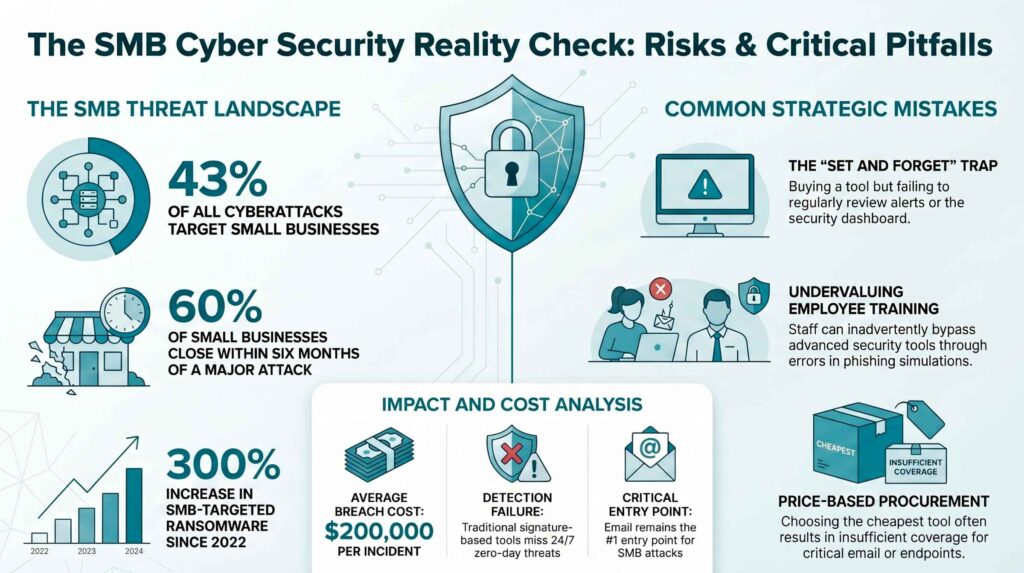
The Verizon 2024 Data Breach Investigations Report confirms that 46% of all cyberattacks target businesses with fewer than 1,000 employees. That number is climbing in 2026.
Autonomous Phishing: AI Writing Perfect Emails
Traditional phishing emails were easy to spot — poor grammar, suspicious links, generic greetings. However, AI-powered phishing has changed that entirely. Attackers now use large language models to craft perfectly written, highly personalized emails. These messages reference your actual clients, recent invoices, and your business name.
For small businesses without email security filters, these emails land directly in inboxes. One click can install ransomware, steal credentials, or open a backdoor into your entire network. Learning how to spot phishing emails remains a critical first line of defense for any team member who handles email.
Deepfake Vishing: Voice Cloning of Your CEO or Vendors
Deepfake vishing (voice phishing) represents one of the most alarming 2026 threats for SMBs. Attackers clone the voice of a CEO, a vendor, or a bank representative using as little as 30 seconds of audio scraped from public videos or calls. Subsequently, they call employees and request urgent wire transfers or credential resets.
Deepfake vishing defense requires more than employee awareness. It demands real-time audio analysis tools and strict callback verification protocols. We covered how AI can detect deepfake audio in real time — a must-read if your team handles any financial transactions by phone.
Shadow AI Data Leaks: Employees Pasting Sensitive Data Into Chatbots
Shadow AI is the quiet crisis inside thousands of small businesses right now. Employees routinely paste customer data, financial records, and proprietary information into public AI chatbots like ChatGPT. They do this to save time — and they often have no idea it poses a security risk.
Shadow AI auditing involves monitoring which AI tools employees use and what data flows into them. Without this layer, your confidential business information may be stored on third-party servers indefinitely. Implementing a shadow AI audit policy is one of the simplest and most overlooked steps in modern SMB cybersecurity.
Top 7 Affordable AI Cybersecurity Tools for Small Businesses
Not every AI security tool requires a Fortune 500 budget. Furthermore, many of the best solutions were specifically built with small business workflows in mind — no IT team required to deploy or manage them.
| Product Name | Primary Use Case | Starting Price | Key AI Features | Operational Limitations | Target Team |
|---|---|---|---|---|---|
| MS Defender for Business | M365 Integrated Security | $3/user/mo | Vulnerability scoring & EDR | Basic reporting; M365 dependent | 1-300 Users |
| Guardz | All-in-One SMB Security | $9/user/mo | Bundled Email & Endpoint AI | Feature depth is moderate | Micro-SMBs |
| Huntress | Managed Threat Hunting | $10/agent/mo | AI + 24/7 Human Verification | Not a full EPP replacement | No in-house IT |
| CrowdStrike Falcon Go | Elite Endpoint Protection | $59.99/dev/yr | Cloud-native threat hunting | Device pricing scales fast | 5-250 Employees |
| SentinelOne Singularity | Autonomous Response | ~$70/dev/yr | 1-Click Ransomware Rollback | Steeper learning curve | Technical SMEs |
| Abnormal Security | Behavioral Email AI | Custom (~$4/mo) | Writing style BEC detection | Email-only focus | All (Phishing focus) |
| Darktrace Essentials | Network Anomaly Detection | Custom | Self-learning “Normal” baseline | Lengthy onboarding | 10-500 Employees |
Pro Tip: Don’t just buy an AI security tool — verify it includes Automated Endpoint Isolation. If ransomware hits at 2 AM, the AI must automatically disconnect the infected laptop from your network before you wake up. Without this feature, one infected machine can compromise your entire operation within minutes.
Microsoft Defender for Business is an outstanding starting point for most SMBs. It integrates directly with Microsoft 365, which most small businesses already use. Additionally, its AI engine monitors behavioral patterns across all devices and flags anomalies in real time. You can learn more about best cybersecurity companies to compare broader enterprise-level options as your business scales.
CrowdStrike Falcon Go brings enterprise-grade automated endpoint isolation to SMBs at a fraction of traditional costs. Meanwhile, Cloudflare Zero Trust offers a free tier that provides meaningful protection for businesses just beginning their security journey.
How to Build an Autonomous “SOC” Without an IT Team (Step-by-Step)
A Security Operations Center (SOC) traditionally requires a team of trained analysts working in shifts. However, an autonomous SOC powered by AI can replicate those capabilities at a fraction of the cost. Here is exactly how to set one up for your small business.
Step 1: Deploy AI-Driven Endpoint Detection and Response (EDR)
Every device that connects to your business network — laptops, phones, tablets — is a potential entry point. Therefore, your first step is deploying an AI-driven EDR solution on all endpoints.
EDR tools continuously monitor device behavior. They detect suspicious activity — like a Word document suddenly attempting to access your payroll files — and respond automatically. CrowdStrike Falcon Go and SentinelOne Singularity Core both offer automated isolation, meaning a compromised device gets cut off from the network instantly, without human intervention.
Setup takes less than 30 minutes. Most tools provide a lightweight agent that installs via a simple download link sent to each employee.
Step 2: Automate Email Filtering with NLP
Natural Language Processing (NLP) allows AI to read and understand email content the same way a human analyst would — but faster and at scale. NLP-powered email filters analyze sender behavior, linguistic patterns, and embedded links simultaneously.
Microsoft Defender for Business includes built-in NLP email protection when paired with Microsoft 365 Defender. Alternatively, tools like Proofpoint Essentials and Mimecast offer SMB-focused NLP filtering. After deployment, AI-driven email security blocks over 99% of phishing attempts before they reach your inbox.
For businesses that want to go further, you can even build an AI phishing detector for your inbox using no-code tools — a practical guide we published specifically for non-technical business owners.
Step 3: Implement Zero-Trust Identity Verification
Zero-trust architecture for SMBs operates on a simple principle: trust nobody, verify everyone. Consequently, even if an attacker steals an employee’s password, they cannot access your systems without passing additional verification.
Passkeys and hardware security keys are now the gold standard. Google and Microsoft both support passkey authentication across their platforms. Cloudflare Zero Trust extends this principle to your entire web infrastructure, verifying every user and device before granting access to internal tools.
The ultimate guide to network security in cloud computing provides an excellent deeper dive into zero-trust principles for cloud-first businesses.
Step 4: Set Up Automated Security Alerts via No-Code Automation
This is where your autonomous SOC becomes truly intelligent. By connecting your security tools to a no-code automation platform like Make.com, you can trigger instant Slack or Teams alerts whenever a threat is detected — without writing a single line of code.
For example, when CrowdStrike detects a suspicious login from an unusual location, Make.com can simultaneously alert your Slack channel, lock the account, and log the incident in a Google Sheet. All of this happens automatically, in seconds.
We published a full tutorial on automating malware scanning in Google Drive using Make.com that walks through the exact workflow setup. Similarly, our guide on automating WhatsApp scam detection with OpenAI and Make.com shows how to extend AI security to messaging platforms where employees increasingly conduct business.
For a broader understanding of how low-cost AI tools can transform small business operations, our guide to low-cost AI agents for small business workflows is an essential companion read to this article.
The ROI of AI Security: Budgeting for 2026
One of the most common objections we hear from small business owners is: “We can’t afford cybersecurity tools.” However, the math tells a very different story.
According to IBM’s Cost of a Data Breach Report, the average cost of a data breach for small and medium businesses now exceeds $3.3 million when factoring in recovery, lost revenue, legal fees, and reputational damage. Moreover, 60% of small businesses close within six months of a significant breach.
| Scenario | Annual Cost |
|---|---|
| Microsoft Defender for Business (10 users) | $360/year |
| CrowdStrike Falcon Go (10 users) | $599/year |
| Cloudflare Zero Trust (10 users) | $840/year |
| Full No-IT AI Security Stack (10 users) | ~$1,800/year |
| Average SMB Data Breach | $3,300,000+ |
The return on investment is not subtle. Spending $1,800 per year to protect against a $3.3 million loss represents one of the highest-ROI decisions any small business owner can make in 2026.
Furthermore, many cyber insurance providers now offer premium discounts of 15–30% for businesses that can demonstrate active AI security monitoring. As a result, your AI security stack may effectively pay for itself through insurance savings alone.
If you are just beginning to think about how AI intersects with your business security posture, our article on whether AI can fully handle cybersecurity provides a balanced, detailed analysis of AI’s current capabilities and limitations.
For business owners who want to understand the broader AI landscape before investing, our beginner’s guide to learning AI in 2026 is an excellent starting point that requires zero technical background.
2026 SME AI Feasibility Matrix 📊
Not all AI technologies are equally practical for small businesses. Some require significant infrastructure, while others are ready to deploy instantly.
AI Deployment Feasibility for SMEs
| AI Technique | Resources Required | Complexity | SME Score (1–10) |
|---|---|---|---|
| Deep Learning | High (GPU) | Moderate | 5 |
| Federated Learning | Moderate | High | 6 |
| Classical ML | Low (CPU) | Low | 9 |
| Cloud-Based MDR AI | Minimal | Very Low | 10 |
From my experience, cloud-based AI security solutions offer the best balance of cost, performance, and simplicity.
Securing Generative AI Usage in Your Team 🤖
Generative AI tools are widely used in modern workplaces. However, they introduce new security risks.
Employees often unknowingly share sensitive data while using these tools. That data can become exposed externally.
Therefore, you must define clear AI usage policies.
Key AI Usage Guidelines
- Allow non-sensitive use only
- Prohibit sharing confidential data
- Require human review of outputs
- Monitor usage patterns regularly
A well-defined policy ensures your team benefits from AI without exposing your business.
FAQs
What is AI cybersecurity for small businesses?
AI cybersecurity for small businesses refers to the use of machine learning and autonomous software agents to detect, prevent, and respond to cyber threats. Unlike traditional security tools that require human monitoring, AI-powered solutions operate continuously and independently — making them ideal for businesses without dedicated IT staff.
How much does AI cybersecurity cost for a small business?
AI cybersecurity tools for small businesses typically cost between $3 and $10 per user per month. For a team of 10 employees, a comprehensive AI security stack generally costs between $1,500 and $2,500 annually — a fraction of the average data breach cost of $3.3 million.
Can small businesses protect themselves without an IT team?
Yes, absolutely. In 2026, tools like Microsoft Defender for Business, CrowdStrike Falcon Go, and Cloudflare Zero Trust are specifically designed for non-technical users. Combined with no-code automation platforms like Make.com, small businesses can deploy a fully autonomous security system without hiring a single IT professional.
What is shadow AI and why is it dangerous for SMBs?
Shadow AI refers to unauthorized use of AI tools — like public chatbots — by employees without organizational approval or oversight. It becomes dangerous when employees paste sensitive business data, customer records, or financial information into these platforms. That data may be stored, used for training, or exposed in future breaches. Shadow AI auditing helps businesses identify and control this risk.
What is zero-trust architecture and does my small business need it?
Zero-trust architecture means every user, device, and network request must be verified before being granted access — even those inside your organization. In 2026, with remote work and cloud tools dominating SMB operations, zero-trust is no longer optional. Tools like Cloudflare Zero Trust make it affordable and manageable without an IT team.
Final Thoughts
AI cybersecurity for small business has fundamentally changed the equation. The barriers that once made enterprise-grade security inaccessible to SMBs — cost, complexity, and the need for dedicated staff — have effectively been removed.
The threats are real, they are growing, and they are increasingly automated. However, so is your defense. By deploying the right AI tools, implementing zero-trust identity verification, and connecting your security alerts through no-code automation, you can build an autonomous SOC that protects your business around the clock.
Start with one tool. Master it. Then add the next layer. The most dangerous move in 2026 is not starting at all.
Ready to take the next step? Read our full guide on how to become a hacker — and think like one to understand the adversarial mindset that will sharpen every security decision you make. Alternatively, explore threat intelligence fundamentals to understand how professional defenders stay ahead of attackers in 2026.
Your business is worth protecting. Start today.