Every enterprise on the planet is racing to adopt AI. Billions of dollars are flowing into machine learning pipelines, generative models, and intelligent automation platforms. Yet most of these transformations stall — not because the technology fails, but because the governance structure never existed in the first place.
AI transformation is a problem of governance. That is the uncomfortable truth that most technology leaders are not yet ready to say out loud. Organizations invest heavily in tools. They invest almost nothing in the accountability structures, ethical policies, and decision-making frameworks that determine whether those tools help or harm.
After working alongside digital teams across sectors, I’ve seen this pattern repeatedly: the AI works. The institution isn’t ready. This article breaks down why governance is the real bottleneck — and what you can do about it today.
What Most Organizations Get Wrong About AI Transformation
Most companies treat AI adoption as a technology project. Consequently, they hand it to the IT department, buy a few SaaS subscriptions, and call it digital transformation. That approach is fundamentally broken.
AI systems do not just automate tasks. They make decisions. They allocate resources. They influence hiring outcomes, loan approvals, medical diagnoses, and criminal risk assessments. When a model makes a flawed decision, someone must be accountable. However, in most enterprises, nobody is.
Furthermore, the speed of AI deployment far outpaces the speed of policy creation. A team can deploy a generative AI tool in a single afternoon. Writing a clear acceptable use policy, meanwhile, takes months. This gap is where governance failures are born.
The organizations winning at AI in 2026 — whether in New York, London, or Singapore — are not the ones with the most advanced models. They are the ones who built a governance layer before they scaled.
Why AI Governance Is the Real Bottleneck
Governance is not bureaucracy. Governance is the mechanism that makes AI transformation sustainable. Without it, every AI project is a liability waiting to surface.
Consider the evidence. A 2024 IBM Institute for Business Value report found that 42% of enterprises said a lack of AI governance was the primary barrier to scaling AI initiatives. Similarly, McKinsey’s global AI survey found that only 21% of companies had implemented any formal AI risk management program, despite 65% actively deploying AI tools.
In other words, the technology is running ahead of the rules. That is not an IT problem. That is a leadership and governance problem.
The Three Layers of AI Governance
Effective AI governance operates across three distinct layers. Understanding these layers is critical before building any framework.
Layer 1 — Policy Governance: This covers acceptable use policies, data handling rules, and ethical boundaries for AI deployment. It defines what AI can and cannot do within your organization.
Layer 2 — Operational Governance: This covers how AI systems are monitored, audited, and corrected in real time. It includes model performance tracking, bias detection, and incident response protocols.
Layer 3 — Strategic Governance: This covers who owns AI decisions at the executive level. It defines board-level AI accountability, links AI outcomes to business strategy, and aligns AI investments with long-term organizational values.
Most enterprises only partially address Layer 1. Layers 2 and 3 remain largely ungoverned.
AI Transformation Without Governance — Real Consequences
The absence of AI governance creates measurable, documented harm. The table below captures documented failures directly tied to ungoverned AI deployment in global enterprises.
| Sector | Governance Failure | Consequence |
|---|---|---|
| Financial Services | Biased credit-scoring algorithms | Discriminatory loan denials in minority communities (US, 2023) |
| Healthcare | Unaudited diagnostic AI models | Misdiagnosis rates 11% higher in underserved populations (UK NHS, 2024) |
| Hiring & HR | AI resume screeners without bias audits | Systematic filtering of female candidates in tech roles |
| Law Enforcement | Facial recognition with no oversight | Wrongful arrests in Detroit and New Orleans |
| Education | AI grading systems with no transparency | Grading inconsistencies disadvantaging ESL students in Asia-Pacific |
| Customer Service | Ungoverned LLM chatbots | Brand-damaging hallucinations and legally problematic responses |
These are not edge cases. These are recurring failure patterns caused by deploying AI without governance structures. Moreover, as AI systems become more autonomous — moving from recommendation engines to agentic AI systems — the stakes grow exponentially.
Building an Effective AI Governance Framework
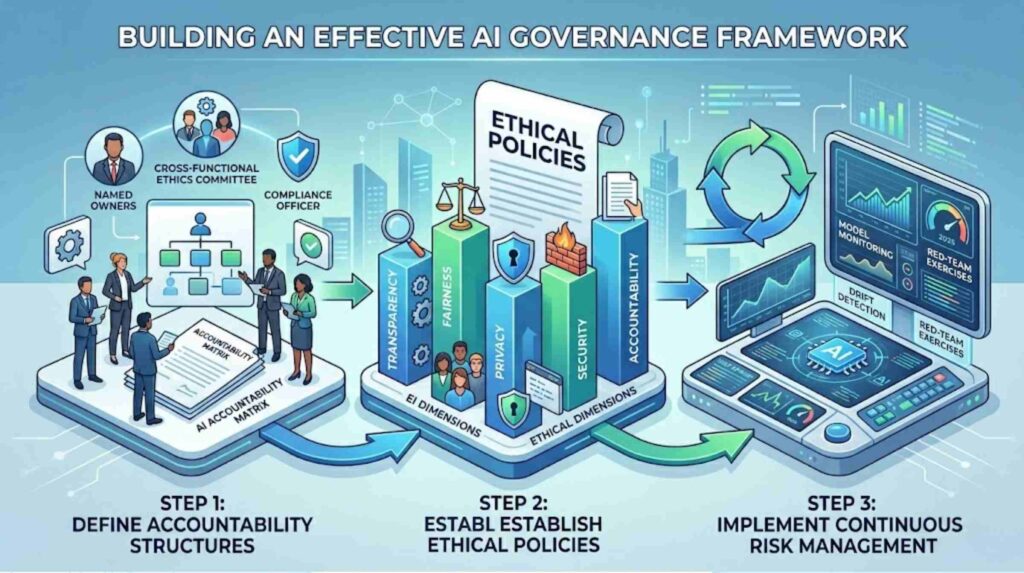
Building an AI governance framework is not a one-time exercise. It is an ongoing operational discipline. However, every organization must start somewhere. Here is a practical, phased approach.
Step 1: Define AI Accountability Structures
Governance without accountability is decoration. Therefore, the first step is assigning explicit human ownership to every AI system in production.
This means creating an AI Accountability Matrix — a living document that maps every active AI tool to a named owner, a department head, and a risk classification. For high-stakes AI (systems that affect people’s livelihoods, health, or legal status), accountability must escalate to the C-suite or board level.
Additionally, organizations should establish a cross-functional AI Ethics Committee. This body should include voices from legal, compliance, HR, engineering, and — critically — end-user communities. Governance cannot be built in isolation from the people AI affects.
In my direct experience advising early-stage tech teams, the single most impactful governance action is deceptively simple: make someone personally responsible for the outcome of every AI decision. Anonymous AI is dangerous AI.
Step 2: Establish Ethical AI Policies
Ethical AI is not a soft concept. It is a set of enforced, measurable commitments. Your ethical AI policy must address five non-negotiable dimensions:
- Transparency: Can you explain how the AI reached its decision? If not, you should not deploy it in a high-stakes context.
- Fairness: Has the model been audited for bias across demographic groups? Is that audit documented and repeatable?
- Privacy: Does the AI system collect, process, or infer personal data? If so, does it comply with GDPR in the EU, CCPA in California, or applicable regional data law?
- Security: Has the model been stress-tested for adversarial inputs and prompt injection attacks?
- Accountability: Is there a documented escalation path when the AI causes harm?
Ethical policies must be living documents. Consequently, they should be reviewed at minimum every six months — or whenever a major model update occurs.
Step 3: Implement Continuous AI Risk Management
Static governance fails dynamic systems. AI models drift. Data distributions shift. What worked at deployment may behave differently six months later. Therefore, governance frameworks must include continuous monitoring mechanisms.
Implement automated model performance dashboards. Track accuracy, fairness metrics, and output drift in real time. Furthermore, schedule regular red-team exercises — structured attempts to find failure modes before real-world users do.
For organizations operating in regulated sectors, this continuous monitoring is not optional. The NIST AI Risk Management Framework provides a globally recognized structure for operationalizing AI risk management across the enterprise.
What Good AI Governance Looks Like in Practice
Good AI governance is not invisible. You can see it operating in the daily decisions of a well-structured organization.
It looks like a data science team that cannot push a model to production without a completed AI Risk Assessment form. It looks like a legal team that reviews every third-party AI vendor contract for data handling clauses. It looks like a monthly AI audit report that goes directly to the CEO.
Conversely, it also looks like the discipline to slow down. The willingness to say, “This AI application is not ready because we cannot yet explain its decisions to the people it affects.” That restraint — that governance reflex — is what separates trustworthy AI organizations from reckless ones.
For teams building internal tools, the same logic applies whether you’re working with no-code automation platforms or enterprise-grade ML infrastructure. The scale differs; the governance principles do not.
The Role of Leadership in AI Governance
AI governance fails most often at the top. Leaders delegate AI to technical teams and assume the risk follows. It does not. Risk follows accountability, and accountability must start with leadership.
CEOs and boards in 2026 need to answer three direct questions about their AI portfolio:
First, which AI systems make or influence decisions that affect people? Second, who is accountable when those decisions cause harm? Third, what is our documented process for auditing, correcting, and improving those systems?
If the answers are unclear, the organization does not have an AI problem — it has a governance problem. Organizations that understand this distinction — like the ones covered in our breakdown of the best cybersecurity companies — build governance infrastructure before they build AI infrastructure.
Furthermore, leadership must champion AI literacy. You cannot govern what you do not understand. Leaders who start learning AI fundamentals — even at a conceptual level — make dramatically better governance decisions than those who remain deliberately uninformed.
The Global Regulatory Landscape for AI Governance
Governments are no longer waiting for enterprises to self-regulate. Globally, the regulatory environment is hardening fast.
The EU AI Act — the world’s first comprehensive AI regulation — classifies AI systems by risk level and mandates strict governance requirements for high-risk applications. Organizations operating in Europe that deploy AI in hiring, education, law enforcement, or critical infrastructure must comply or face fines of up to €35 million.
In the United States, the Executive Order on Safe, Secure, and Trustworthy AI has accelerated federal agency AI governance requirements. The UK is pursuing a sector-specific regulatory model. Meanwhile, countries across Asia-Pacific — from Singapore to South Korea — are publishing national AI governance codes.
The direction is clear: AI transformation without governance is becoming not just a business risk but a legal one. Additionally, organizations that build governance proactively will have a structural competitive advantage over those that build it reactively — after the regulator knocks.
For deeper context on how AI intersects with digital privacy and security, our guide on how to stop AI from reading your Gmail explores practical personal-level governance actions anyone can take today.
Pros and Cons of Implementing a Formal AI Governance Framework
Pros:
- Reduces legal and regulatory exposure significantly
- Builds stakeholder and customer trust in AI-powered products
- Improves AI system performance through systematic auditing
- Creates a defensible record in the event of AI-related incidents
- Enables faster, more confident AI scaling long-term
Cons:
- Requires upfront investment in people, process, and tooling
- Can slow initial AI deployment timelines
- Demands ongoing cross-functional collaboration and buy-in
- Governance policies can become outdated quickly without active maintenance
The evidence strongly favors governance investment. The short-term friction is real. However, the long-term cost of ungoverned AI is consistently higher — financially, reputationally, and ethically.
Frequently Asked Questions
What exactly does “AI governance” mean in an organizational context?
AI governance refers to the policies, accountability structures, oversight mechanisms, and ethical standards that guide how an organization develops, deploys, and monitors AI systems. It answers who is responsible for AI outcomes, how AI decisions are audited, and what happens when AI causes harm.
Why do so many AI transformation projects fail?
Most AI transformation projects fail because organizations invest in technology without investing in governance. They deploy AI without clear accountability, ethical policies, or monitoring structures. As a result, the AI behaves unpredictably, causes unintended harm, or fails regulatory scrutiny — stalling the broader transformation initiative.
Is AI governance only relevant for large enterprises?
No. AI governance is relevant for any organization using AI systems that affect people — regardless of size. Small businesses using AI hiring tools, customer service chatbots, or automated workflows still need basic accountability structures and usage policies to protect themselves and their customers.
How does AI governance relate to cybersecurity?
AI governance and cybersecurity are deeply interconnected. Ungoverned AI systems create new attack surfaces — including prompt injection vulnerabilities, deepfake-enabled fraud, and data poisoning risks. A complete AI governance framework always includes a cybersecurity component that addresses AI-specific threat vectors.
What is the first step a business should take toward AI governance?
The first step is a simple AI audit: list every AI tool currently in use across the organization, identify what decisions each tool influences, and assign a named human owner to each one. This accountability mapping is the foundation of every mature AI governance program. From there, you can layer in ethical policies, risk assessments, and monitoring infrastructure systematically.
The Bottom Line
AI transformation is a problem of governance — and that is not a pessimistic statement. It is a strategic one. The organizations that recognize this truth early are building the governance infrastructure that will allow them to scale AI responsibly, confidently, and competitively.
Technology alone does not transform organizations. Policy, accountability, and human judgment do. The AI is ready. The question is whether your governance framework is ready for the AI.
At Upstanding Hackers, we cover the full spectrum of responsible AI adoption — from understanding the difference between AI and machine learning to building AI tools that don’t compromise your privacy. Explore our AI & Automation category for practical, governance-conscious guides built for real teams.
Ready to strengthen your organization’s digital security posture? Contact the Upstanding Hackers team for strategic guidance — or write for us if you have governance expertise worth sharing with our growing global community.