As you stand at the cusp of a technological revolution, the question of whether artificial intelligence will surpass human capabilities by 2026 looms large. This article delves into the transformative potential of AI, exploring whether it will coexist harmoniously with humans or emerge as a formidable competitor. The implications of this evolution are vast, affecting industries, economies, and the very fabric of society. By examining current trends and future projections, you will gain insight into the intricate dance between innovation and human ingenuity, setting the stage for a thought-provoking exploration of our shared future with AI.
How Does AI Affect Humans?
Daily Integration and Enhancement
Artificial intelligence (AI) has transformed daily life, intricately weaving itself into our routines, often without notice. From smart home devices to digital assistants and autonomous vehicles, AI helps optimize tasks by learning and adapting to user preferences. This seamless integration empowers personalized and efficient experiences, changing how we interact with the world around us. Additionally, industries like e-commerce and finance use AI to enhance customer experiences through personalized shopping recommendations and fraud detection.
Societal Shifts and Concerns
Despite these advancements, the expanding reach of AI raises several ethical and societal concerns. As AI becomes a more central player in decision-making processes—ranging from media recommendations to financial credit assessments—it risks influencing human behavior in profound ways. Concerns over AI’s potential bias, stemming from skewed training data, highlight the critical need for ethical guidelines to govern its development and deployment. Moreover, the potential for job displacement and the erosion of human connections are pressing issues that society must address to ensure that humans and AI coexist harmoniously.
Empowerment and Coexistence
For AI and humans to coexist rather than compete, a balanced approach is paramount. AI can significantly bolster productivity and creativity, offering tools that extend human capabilities. By promoting the development of human skills that complement AI, such as critical thinking and emotional intelligence, we can harness AI as a collaborator, not a competitor. Investment in education and ethical AI practices will lay the groundwork for a future in which AI’s potential is fully realized and its risks are mitigated. As we progress toward 2026, focusing on these areas will define the nature of AI and human coexistence.
What Is the 30% Rule in AI?
Balancing Human and AI Collaboration
The 30% rule in AI suggests a framework where artificial intelligence handles approximately 70% of repetitive tasks, while humans focus on the critical 30% that necessitates creativity, judgment, and ethical consideration. By doing so, this paradigm seeks a harmonious coexistence of AI and humans, rather than a competitive landscape. The core idea is to leverage AI’s efficiency in routine functions, thus freeing individuals to engage in activities requiring nuanced thinking and human empathy. Such an approach reinforces that AI can augment human capabilities if its role is carefully defined and managed.
Bridging Automation and Ethical Considerations
This model also addresses concerns about AI-induced workforce disruption. While automation can enhance efficiency, it may instill anxiety due to potential job losses. Maintaining a “human in the loop” structure ensures AI aligns with human values and ethical norms. It provides meaningful insights and retains accountability and transparency. Adjustments to the exact 30% allocation should be context-specific, as some industries may require different levels of human input to preserve job integrity and ensure that AI tools are supportive, not replacements.
Which Three Jobs Will Survive AI?
Healthcare Professionals
By 2026, healthcare roles such as nurse practitioners and physician assistants are predicted to remain essential. These professions require a profound level of empathy, care, and interpersonal skills that AI struggles to replicate. Nurse practitioners are expected to see a growth of 45.7%, as their tasks involve assisting with patient care and making critical decisions based on nuanced symptoms. Similarly, physician assistants are poised for significant growth, given the high demand for their ability to express compassion and exercise complex decision-making skills during direct patient interactions. These roles highlight the unique human touch that AI cannot replicate.
Creative Professions
Jobs in the creative sector, such as choreographers, artists, and musicians, demonstrate the resilience of human originality and innovation. AI may assist or augment creativity, but it cannot entirely replace the ingenuity and emotional depth inherent in creative endeavors. Choreographers, for example, utilize their improvisational skills to create performances that resonate on an emotional level, which remains a challenging feat for AI to fully achieve.
Skilled Trades
Skilled trades like electricians and plumbers continue to be integral to society, thanks to the practical skills and problem-solving abilities they require. These jobs involve dexterous tasks and hands-on work that AI finds difficult to emulate, ensuring their longevity well beyond 2026. Professionals in these fields apply adaptive thinking and essential manual skills in real-world settings, making them indispensable in our tech-driven world.
Redefining Processes Is Better Than Reassigning Tasks
Emphasize Human-AI Synergy
In today’s rapidly evolving technological landscape, AI and humans together form an unparalleled alliance—a prime example of how intelligent redesign can transform industries. Rather than simply reallocating tasks to artificial intelligence, organizations are discovering immense value in redefining entire workplace processes. This approach not only ensures that technological advancements align with core business values but also enhances productivity by balancing strengths unique to both humans and AI. By intentionally leveraging AI’s computational power alongside human creativity and emotional intelligence, businesses can maintain a nuanced and ethical decision-making framework as seen in diverse sectors.
Keeping Humans in the Loop
Effective AI vs humans collaborations depend heavily on embracing the harmonious integration of these two forces. Successful processes engage human workers in roles that AI cannot replicate, such as tasks requiring empathy, judgment, and ethical considerations. More importantly, keeping humans actively involved allays fears of technological displacement, fostering an environment of mutual growth and adaptation. As noted, empowering employees with AI tools—rather than positioning them as replacements—ensures technological advancements contribute to genuine, shared success in practice.
Continuous Improvement and Adaptation
Redefining processes demands a commitment to ongoing assessment and evolution. Organizations must continuously refine workflows to better align with emerging technologies and evolving human roles. This requires leadership that appreciates the intricate balance between new toolsets and workforce capabilities, fostering environments where human skills are enhanced—not overshadowed—by AI as advancements unfold. Such adaptability ensures that AI remains a tool that augments human potential, rather than diminishes it, ushering in a future where shared intelligence drives unparalleled innovation and success.
Combinations Work When Humans and AI Do What They Do Best
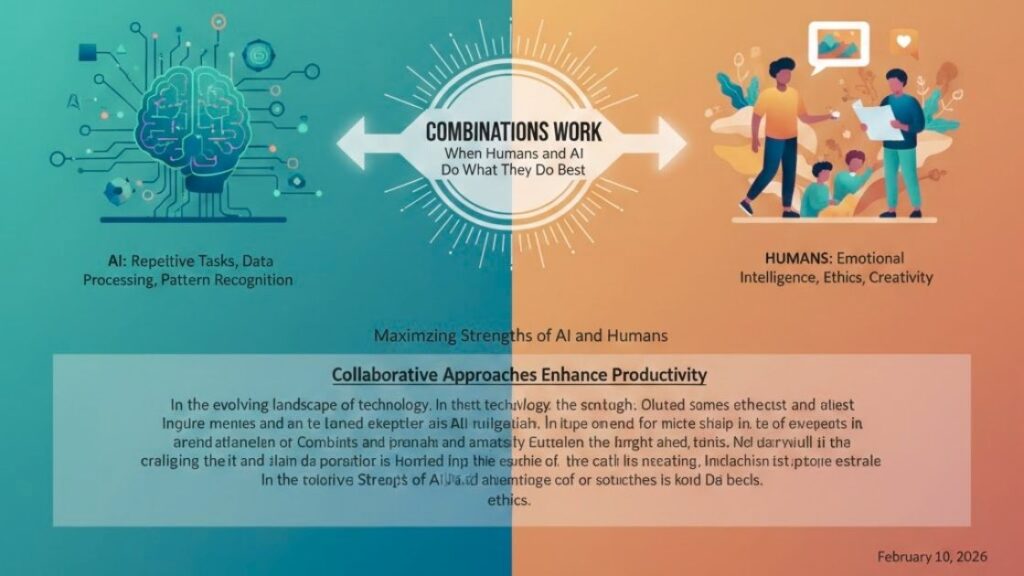
Maximizing Strengths of AI and Humans
In the evolving landscape of technology, the question arises whether AI and humans will coexist harmoniously or compete fiercely for dominance by 2026. At its core, the answer lies in recognizing the distinct strengths that both humans and AI bring to the table and combining them for maximum efficacy.
AI shines in executing repetitive tasks, processing vast amounts of data, and recognizing patterns quickly and efficiently. This computational prowess allows AI to tackle problems at a scale that would be daunting for human beings. For example, AI algorithms can swiftly analyze medical imaging, potentially diagnosing diseases with remarkable accuracy. Meanwhile, humans excel in tasks that require emotional intelligence, ethical considerations, and creative problem-solving—qualities that machines have yet to genuinely replicate.
Collaborative Approaches Enhance Productivity
Instead of viewing AI vs humans as a zero-sum game, one can see the potential for collaboration to unlock new levels of productivity and innovation. AI systems can serve as powerful tools to augment human decision-making. In industries like finance and healthcare, human experts can work alongside AI to interpret results, apply contextual judgment, and make nuanced decisions that respect human values and ethics.
What Does the Bible Say About Artificial Intelligence?
AI Through a Biblical Lens
Examining artificial intelligence (AI) through a biblical perspective, it’s crucial to acknowledge that the Bible does not explicitly address modern technologies like AI. However, the principles it contains offer guidance. Technology, including AI, is seen as a tool that can be used for both beneficial and detrimental purposes. The Bible suggests that tools are not inherently evil but depend on human intention and use, aligning with theological reflections on AI.
Moral and Ethical Implications
From a Christian worldview, humans are created in the image of God, leading to distinct moral and ethical responsibilities in handling AI. This perspective emphasizes that while AI can augment our capabilities, it cannot replicate aspects central to human identity, such as creativity and empathy. The use of AI should support human dignity and community, reinforcing rather than undermining these God-given vocations.
Spiritual Concerns and Opportunities
AI brings spiritual concerns, particularly the risk of humans seeking guidance from AI systems rather than divine wisdom. Christians are warned against viewing AI as a substitute for God’s truth. On the flip side, AI offers opportunities to advance the gospel, such as improving the accessibility of biblical texts worldwide. Guided by biblical truths, Christians are called to engage with AI in ways that honor God and serve humanity. Pursuing this balanced approach helps ensure AI and humans coexist beneficially while preventing competition from overshadowing spiritual truths.
Will AI Surpass Humans by 2026?
Technological Advancements and Predictions
As AI continues to evolve, the question arises: will AI surpass humans by 2026? This debate has sparked various perspectives within the tech community. Notably, tech luminaries, including Elon Musk, suggest that AI may surpass human intelligence as early as 2026, potentially leading to an era of artificial superintelligence where machines can outperform humans in most fields. However, some experts propose a more conservative timeline, anticipating these capabilities to emerge closer to 2040.
Implications for Coexistence or Competition
The potential surpassing of human intelligence by AI raises critical questions about coexistence versus competition. A future where AI and humans coexist harmoniously hinges on responsible development and governance. While AI stands to augment productivity, it also presents risks of job displacement and economic inequality. Balancing these aspects will require strategic interventions like upskilling and adaptable regulations to ensure AI complements rather than competes with human capabilities.
Ethical Considerations and Future Outlook
The ethical considerations surrounding developing AI systems, especially those that challenge the intellect of humanity, are paramount. Many experts emphasize the significance of guiding AI’s growth while upholding human values and ethics. How society navigates these advancements could determine whether AI and humans coexist, with AI serving as an ally in addressing global challenges rather than an adversary.
Conclusion
In considering the trajectory of AI’s evolution, you stand at a pivotal moment in technological history. By 2026, the coexistence and competition between AI and humans will likely redefine industries and daily life. As AI advances, it is crucial for you to embrace a symbiotic relationship, leveraging AI’s capabilities while fostering human creativity and empathy. Whether AI surpasses human capabilities in certain areas remains to be seen, but your role in shaping ethical frameworks and guiding responsible AI development will be paramount. Ultimately, your proactive engagement will determine whether AI serves as a competitor or a collaborative partner.