You have checked Google Search Console three times this week. Impressions are up. Rankings look exactly the same. But clicks are down 25%, 35%, sometimes more. Nothing changed on your site. No penalty. No algorithm flag. So what happened?
This is the most common and most misunderstood traffic problem in 2026. And the answer has nothing to do with your rankings.
Chartbeat’s March 2026 analysis found that small publishers lost 60% of their search referral traffic while large publishers lost only 22%. The gap is not random. It is structural. And it has a specific cause that most small business owners have not been told about yet.
This guide explains exactly what happened, why rankings and traffic are no longer the same thing, and five steps to start recovering clicks this week.
The Great Decoupling: Why Rankings and Traffic Separated
For fifteen years, higher rankings meant more traffic. That relationship broke in 2025 and fully collapsed in 2026.
Analysts call it the great decoupling. Ahrefs measured it on live data. In late 2024, impressions and clicks moved together with a positive correlation of 0.425. By mid-2025, that correlation flipped to negative 0.352. More impressions now often mean fewer clicks.
This means your site can rank in position one, receive thousands of impressions, and generate almost no clicks — all at the same time. Furthermore, this is not a punishment. It is a structural shift in how Google displays search results.
AI Overviews appear on almost half of all searches as of early 2026, and on mobile they take up nearly half of the screen. Many searches now produce an answer before a buyer sees a blue link.
Google answers the question before anyone needs to click. Your ranking is irrelevant if the user never scrolls past the answer block.
For small businesses specifically, this hits harder than for large brands. Informational queries trigger AI Overviews 39.4% of the time — and small businesses typically rely on informational content at the top of their funnel to drive discovery. Those are exactly the queries now being answered on the page without a click.
This is important to understand before panicking: your site did not get worse. Google did not stop liking your content. The rules changed underneath you. The good news is that the fix is real and it is achievable without starting from zero. Our guide on generative engine optimization for small business covers the full strategic response to this shift.
What AI Overviews Are Doing to Your Clicks
When a user searches for something your page ranks for, one of three things now happens:
Scenario A: Google displays an AI Overview directly answering the query. The user reads it and leaves. Your page gets an impression. You get zero clicks. Your ranking is unchanged. This is the zero-click problem.
Scenario B: Google displays an AI Overview and cites your page as a source. The user may click your citation link — but only if they want more detail. Citation clicks are typically 20–30% of what a traditional position-one click-through rate used to generate.
Scenario C: No AI Overview appears. The user sees traditional results and clicks normally. This is increasingly rare for informational queries in 2026.
According to Metricusapp’s 2025–2026 data, organic click-through rate drops 61% when an AI Overview appears on a search results page. That is not a minor reduction. That is a cliff.
60% of Google searches now end without any click at all — the user gets their answer from the search results page and never visits a website.
Consequently, if your content strategy relies primarily on informational blog posts answering common questions, your traffic will continue declining regardless of your rankings. The solution is not to rank better. The solution is to appear inside the AI Overview and to focus your energy on commercial and transactional content that AI Overviews trigger less frequently.
For deeper context on how AI agents are reshaping the buyer journey — and how businesses are adapting their content strategies as a result — our guide on AI agents for business covers the full picture.
How to Diagnose Your Specific Traffic Drop
Before applying any fix, spend 20 minutes diagnosing which of the three causes is driving your specific drop. Open Google Search Console and run these three checks.
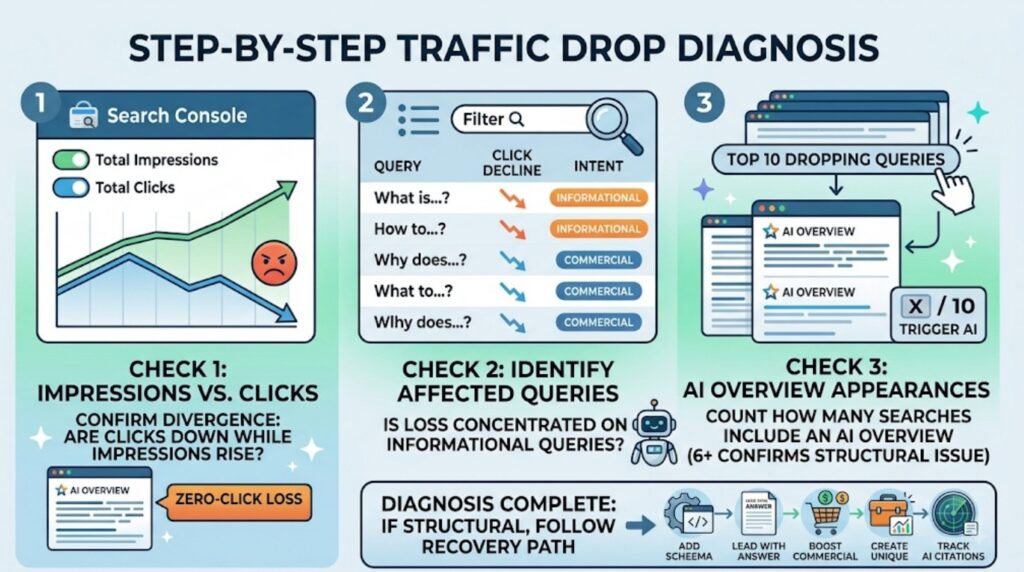
Check 1 — Impressions vs. clicks divergence. Go to Performance → Search results. Set the date range to the last 16 months and enable both Total Clicks and Total Impressions. If impressions held steady or increased while clicks declined, you are experiencing zero-click loss from AI Overviews — not a ranking drop. This is the most important diagnosis because it confirms the structural cause rather than a content quality issue.
Check 2 — Identify affected queries. Filter by query type and sort by click decline over the last six months. Look for patterns: are the dropping queries primarily informational (what is, how to, why does) or commercial (best, price, near me, buy)? Informational queries are the primary AI Overview trigger. If your losses concentrate there, AI Overviews are the cause.
Check 3 — Check for AI Overview appearances. Search your top 10 dropping queries directly in Google. Count how many trigger an AI Overview. If six or more do, your traffic issue is confirmed as structural — and the five steps below are your recovery path.
Additionally, check whether your pages appear as cited sources inside any of those AI Overviews. If you appear as a citation but clicks are still low, your content is being consumed without a click. The fix there is different: optimize for commercial intent pages instead, where conversions happen even with lower traffic volume.
Our basics of SEO writing guide covers how to restructure existing informational content to serve both traditional rankings and AI citation placement simultaneously.
5 Steps to Recover Traffic Without Losing Your Rankings
These steps do not require starting over. They restructure what you already have to perform better in the 2026 search environment.
Step 1 — Add FAQPage schema to your top 10 pages. Pages with FAQPage schema are consistently more likely to be cited in AI Overviews — and any page structured clearly enough for AI to extract a direct answer is eligible regardless of domain authority. Use Google’s free Structured Data Markup Helper. Add JSON-LD FAQ markup to every page losing clicks. This is the fastest single action with measurable AI visibility impact.
Step 2 — Rewrite your opening paragraphs to lead with the answer. AI Overviews pull from the first direct answer on a page — not from the middle. If your content opens with context-setting paragraphs before getting to the point, AI skips it in favour of a page that opens with the answer. Rewrite the first 60 words of every affected page to deliver a complete, standalone answer to the implied question. Do this before any other content change.
Step 3 — Shift content investment toward commercial-intent pages. AI Overviews impact research-focused queries more than conversion-ready ones. Traffic loss does not always equal lost leads — AI impacts informational queries more than commercial ones. Therefore, prioritize creating and updating service pages, comparison pages, pricing pages, and local landing pages. These query types trigger AI Overviews far less frequently. Consequently, they retain closer to traditional click-through rates even in 2026.
Step 4 — Build content that AI cannot answer without you. The safest traffic in 2026 is traffic that requires a visit. This means original data, personal experience, specific local context, and proprietary frameworks that no AI system can replicate from its training data alone. A blog post explaining “what is email marketing” will lose clicks permanently to AI Overviews. A post titled “how we grew our client’s email list from 400 to 4,200 in 8 months” cannot be answered by AI without linking back to you. Create more of the second type.
Step 5 — Track citation appearances, not just click positions. The 2026 performance metric that matters is not position — it is whether you appear as a cited source inside AI Overviews. Check your top 20 queries manually each month. If you are cited, your brand is building awareness even without clicks. If you are not cited despite ranking, your content structure needs updating. Google Search Console now shows AI Overview impressions separately — monitor this column weekly rather than focusing solely on click data.
For a practical framework on building content that performs across both traditional search and AI citation layers simultaneously, our content marketing strategy guide and content marketing tools guide cover the full production workflow.
The Honest Truth About 2026 Traffic
Some of your informational traffic will not come back. The queries that AI Overviews answer cleanly and completely will continue generating impressions with low clicks indefinitely. Accepting this is important because it redirects energy toward what is recoverable.
The businesses adapting fastest in 2026 are doing three things consistently. They are restructuring content for AI citation rather than click generation on informational pages. They are doubling investment in commercial-intent pages where clicks still convert. And they are building original, experience-based content that AI cannot summarize without referring back to the source.
The traffic loss feels alarming. In most cases, it is a prompt to evolve the content strategy — not evidence that anything is broken. Moreover, the businesses that adapt now will have a structural advantage when AI-search behaviour normalises and the new rules of citation-based visibility become the competitive baseline.
For the technical layer of this recovery — specifically how to structure content so AI systems cite it reliably — our guides on no-code AI automation and agentic SEO for small business are the logical next steps.
FAQs
Why did my website traffic drop if my Google rankings did not change?
Your rankings did not change — but Google is now answering many queries directly on the search results page through AI Overviews. Users read the answer and never click through to any website. This is called zero-click search. It does not affect your ranking position, but it directly reduces the clicks your ranking generates. The fix is content restructuring and a shift toward commercial-intent pages, not attempting to rank higher.
How much traffic loss is normal from AI Overviews in 2026?
Small publishers lost an average of 60% of search referral traffic in 2026 according to Chartbeat’s March analysis, while large publishers lost approximately 22%. Informational content suffers the most. Commercial and transactional content retains closer to historical click-through rates. If your losses are concentrated on how-to and definition-style content, the loss is structural and expected — not a site-specific problem.
Does adding FAQ schema actually help with AI Overview appearances?
Yes. FAQPage schema is the single highest-impact technical change for improving AI Overview citation rates in 2026. It signals to Google’s AI systems that your content is structured as direct question-and-answer — the exact format AI Overviews prefer for extracting citations. Pages with FAQ schema are cited in AI Overviews at 3.2× the rate of unstructured pages. Use Google’s Structured Data Markup Helper (free) to implement it without coding.
Should I delete my informational content that is losing traffic?
No — not immediately. First check whether those pages are appearing as cited sources inside AI Overviews even if clicks are low. Citation appearances build brand awareness and topical authority signals that support your entire site’s ranking performance. Second, update the content to lead with direct answers and add FAQ schema before considering deletion. Many pages recover meaningful click volume after structural updates. Delete only after updating and monitoring for 90 days with no improvement.
What type of content is most protected from AI Overview traffic loss in 2026?
Four content types retain strong click-through rates despite AI Overviews: original research and proprietary data that AI cannot replicate; local landing pages with specific geographic context; product and service comparison pages with pricing and detailed specifications; and personal experience content documenting specific results with real numbers. Invest in these four types to build a traffic base that is structurally resistant to zero-click search growth.