If you run a business online in 2026, you already know that search has changed dramatically. People no longer type keywords into Google and scroll through ten blue links. Instead, they ask ChatGPT for recommendations, read Google AI Overviews at the top of results, and get instant summaries from Perplexity — all without ever clicking on a single website. This shift is exactly why understanding what is ZipTie AI Search Analytics has become one of the most important questions in digital marketing today.
Traditional SEO tools simply cannot answer this question for you. They track rankings, impressions, and backlinks — but they stay completely blind to what AI systems say about your brand. ZipTie AI Search Analytics fills that gap. It is a dedicated AI visibility monitoring platform built from the ground up for the age of generative search. In this guide, you will discover exactly how it works, why it matters, and how businesses across the US, UK, Canada, Australia, and India are using it to stay competitive right now.
The Search Landscape Has Fundamentally Changed
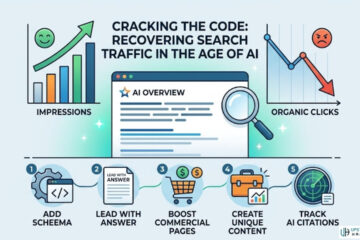
For over two decades, SEO meant one thing: rank higher on Google. However, the rulebook has been rewritten. Google’s AI Overviews now appear at the very top of millions of search results, synthesizing information and delivering a direct answer. Users read that answer and move on — no click required.
This “zero-click” reality carries serious consequences for businesses everywhere. Organic traffic is declining for informational queries because AI absorbs the answer before users reach your website. Brand citations inside AI answers are quickly becoming the new currency of online authority and visibility. Therefore, traditional keyword rankings no longer reflect the full picture of your search performance.
Furthermore, the competition is no longer just between websites. It is between brands — over who gets mentioned, cited, and recommended inside AI-generated responses. If your brand is absent from those responses, your potential customers never know you exist. They find your competitors instead. This is the core problem that ZipTie AI Search Analytics was specifically built to solve.
To understand how AI is reshaping every corner of marketing, explore the AI & Automation category on Upstanding Hackers. Additionally, if you want to understand the broader shift from traditional search to AI-driven discovery, our deep dive into AI augmenting human capabilities provides essential context.
What Is ZipTie AI Search Analytics? A Clear Definition
At its core, ZipTie AI Search Analytics is a specialized monitoring and intelligence platform that tracks your brand’s visibility inside AI-generated search results. Unlike general SEO tools that were designed for the era of blue-link results, ZipTie was built specifically for a world where large language models (LLMs) and AI answer engines synthesize content and pick a few trusted sources to cite.
Put simply, ZipTie answers one question that no conventional analytics tool currently can: What is AI saying about your brand, and how often?
The platform was launched by the team behind Polish SEO agency Onely — Tomasz Rudzki, Bartosz Góralewicz, and Sebastian Skowron. These are SEO professionals who saw the AI search transformation coming early and built a solution from scratch rather than bolting it onto an existing tool. As a result, ZipTie monitors three of the most important AI search engines currently in use globally:
- Google AI Overviews — The AI-generated summaries appearing at the top of Google search results
- ChatGPT — OpenAI’s conversational AI, which users query for recommendations and decisions
- Perplexity — The AI answer engine rapidly gaining traction among researchers and professionals
Moreover, ZipTie operates across multiple regions and countries, including the US, Canada, Australia, UK, India, and Brazil, making it genuinely useful for international brands and global digital marketing teams.
How ZipTie AI Search Analytics Actually Works
Understanding what ZipTie does is straightforward. Understanding how it does it is where the real competitive advantage lives. The platform operates through three core modules: Monitoring, Content Optimization, and Insights.
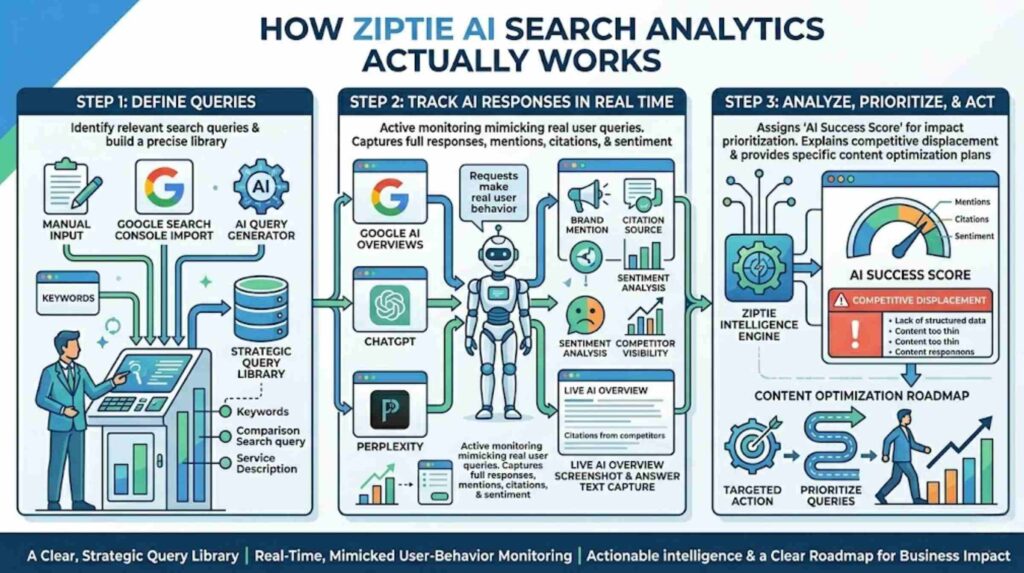
Step 1 — Define the Queries That Matter to Your Business
First, you identify the search queries relevant to your brand. These could be product categories, service descriptions, comparison searches, or informational queries where your target customers evaluate their options. ZipTie provides an AI-powered query generator to help you discover terms your potential customers are actually using. You can also import queries directly from Google Search Console or add them manually.
Consequently, you build a precise, strategic query library rather than guessing which searches matter most. This step alone separates ZipTie from general analytics platforms that track surface-level data without strategic context.
Step 2 — Track AI Responses in Real Time
Once queries are defined, ZipTie actively monitors how Google AI Overviews, ChatGPT, and Perplexity respond to each one. Critically, the platform mimics real user behavior — it queries AI platforms the same way an actual customer would. This approach captures the exact responses that real users see, rather than relying on static scraped data or outdated LLM snapshots.
For each query, ZipTie captures whether your brand is mentioned, whether it is cited as a source, the sentiment behind those mentions, and whether competitors appear instead. The platform also captures live AI Overview results with exact answer text and downloadable screenshots, so your team can audit precisely what users encounter.
Step 3 — Analyze, Prioritize, and Act with the AI Success Score
This is where ZipTie’s intelligence becomes most valuable. The platform assigns each query an AI Success Score — a composite rating based on brand mentions, citations, and sentiment. This score tells you exactly which queries to optimize first for maximum business impact.
Additionally, ZipTie identifies competitive displacement. If ChatGPT recommends three of your competitors when someone searches for your service category but skips your brand entirely, ZipTie explains exactly why. Perhaps your content focuses on features instead of use cases. Maybe you lack the structured data that AI scrapers prefer. Or your thought leadership content is too thin to earn a citation. The platform then provides a clear content optimization roadmap so you can take targeted action.
Key Features That Set ZipTie Apart from Traditional SEO Tools
ZipTie occupies a fundamentally different category from traditional analytics platforms. Understanding this distinction is important before you decide how to integrate it into your marketing stack.
| Feature | ZipTie AI Search Analytics | Traditional SEO Tools (e.g., Ahrefs, SEMrush) |
|---|---|---|
| Google AI Overviews Tracking | ✅ Full monitoring with screenshots | ❌ Not supported |
| ChatGPT Brand Mention Tracking | ✅ Real-time monitoring | ❌ Not supported |
| Perplexity Visibility Monitoring | ✅ Included | ❌ Not supported |
| AI Success Score | ✅ Per-query prioritization | ❌ No equivalent |
| Competitor AI Share-of-Voice | ✅ Detailed competitive view | ⚠️ Limited to SERP rankings |
| Content Optimization Roadmap | ✅ AI-driven recommendations | ⚠️ Keyword-based only |
| Zero-Click Search Insights | ✅ Core feature | ❌ Not supported |
| Multi-Region Tracking | ✅ US, UK, CA, AU, IN, BR | ✅ Available |
| Traditional Keyword Rankings | ❌ Not the focus | ✅ Core feature |
As the table illustrates, ZipTie and traditional tools are complementary — not competitive. Furthermore, agencies like Seer Interactive report deploying ZipTie across hundreds of client queries, some monitoring over 7,800 searches weekly, which demonstrates real enterprise-scale capability.
Who Should Use ZipTie AI Search Analytics?
ZipTie is not only for enterprise SEO teams in the US or UK. It delivers genuine value across multiple roles and business sizes.
Digital Marketing Agencies managing diverse clients will find ZipTie invaluable for reporting AI visibility performance alongside traditional metrics. It transforms client reports from backward-looking ranking data into forward-looking AI presence intelligence.
In-House Marketing Teams at SaaS companies, e-commerce brands, and professional service firms can use ZipTie to secure their branded search presence and monitor how AI tools characterize their products versus competitors.
SEO Professionals who want to stay ahead of the curve will find that ZipTie provides the data layer they need to practice Generative Engine Optimization (GEO) — the discipline of optimizing content for AI-powered search rather than just traditional search engines.
Small Businesses will appreciate that ZipTie offers a 14-day free trial and pricing tiers designed for teams that lack enterprise budgets but still need to compete in AI search across their local and national markets.
Meanwhile, content creators and bloggers who want to understand why their traffic is shifting — even when traditional rankings hold steady — will find ZipTie’s query-level insights genuinely eye-opening. If you are still building your foundational SEO knowledge, start by understanding the basics of SEO writing before adding AI-layer analytics on top.
ZipTie AI Search Analytics and Generative Engine Optimization (GEO)
ZipTie is the data engine that powers a GEO strategy. Without it, you are optimizing blind. With it, you have a clear feedback loop: create content, track whether AI cites it, identify gaps, improve, and measure again.
Understanding the difference between AI and machine learning helps clarify why GEO is a separate discipline. AI search systems do not just match keywords — they understand context, intent, and authority. Therefore, your content must demonstrate genuine expertise and be structured in a way that LLMs can parse, trust, and cite.
ZipTie makes this measurable. It connects what you publish to how AI perceives you — something that was previously impossible to track with conventional tools. For broader context on how a beginner can start learning AI, Upstanding Hackers has a comprehensive guide that pairs well with the practical GEO workflows ZipTie enables.
Furthermore, combining ZipTie insights with the right content marketing tools creates a powerful end-to-end workflow — from identifying what AI currently says about your brand to creating the content that changes it.
According to Search Engine Journal, generative AI features are influencing a rapidly growing share of total search interactions in 2026, making AI visibility monitoring no longer optional for serious marketers.
Pros and Cons of ZipTie AI Search Analytics
- Pros:
- Purpose-built for AI search — not an afterthought feature
- Tracks Google AI Overviews, ChatGPT, and Perplexity in one dashboard
- AI Success Score removes guesswork from prioritization
- Competitive intelligence reveals exactly who is winning AI share-of-voice
- Multi-region tracking covers global markets effectively
- 14-day free trial reduces commitment risk
- Actionable content recommendations, not just data dashboards
- Trusted by SEO agencies managing thousands of queries weekly
- Cons:
- Does not replace traditional SEO tools — must be used alongside them
- Processing speed can vary during high-volume tracking periods
- Pricing may feel steep for very early-stage startups on minimal budgets
- Does not track Bing AI or emerging regional AI search engines yet
How to Get Started with ZipTie
Getting started with ZipTie AI Search Analytics is straightforward. First, sign up for the 14-day free trial at ziptie.dev. Next, define your query library — start with your most important branded and category-level searches. Then, connect your Google Search Console account to import queries you already track. Subsequently, let ZipTie run its initial monitoring cycle and review your first AI Success Score report. Finally, use the content optimization recommendations to prioritize your next content creation or updating sprint.
Additionally, pairing ZipTie with your existing digital marketing strategy amplifies results significantly. For instance, insights from ZipTie can directly inform which topics deserve investment in PPC campaigns for small businesses, affiliate marketing networks, and organic content programs simultaneously.
For teams exploring how to automate parts of this workflow, low-cost AI agents for small business workflows offers practical no-code automation ideas that complement ZipTie’s analytical layer.
As Moz notes, brands that build institutional knowledge around AI visibility early will establish authority in AI systems before their competitors even recognize the shift is happening.
Frequently Asked Questions
Is ZipTie AI Search Analytics the same as Google Analytics?
No. Google Analytics tracks on-site user behavior — sessions, conversions, and traffic sources. ZipTie AI Search Analytics tracks your brand’s visibility inside AI-generated search responses on Google AI Overviews, ChatGPT, and Perplexity. The two tools serve entirely different purposes and work best when used together.
Does ZipTie work for small businesses, or is it enterprise-only?
ZipTie is designed for businesses of all sizes. It offers a 14-day free trial and multiple pricing tiers, making it accessible for small and medium businesses, not just enterprise teams. The AI Success Score feature is especially useful for small businesses because it tells you exactly where to focus your limited content resources first.
How is ZipTie different from traditional rank tracking tools?
Traditional rank tracking tools measure your position in Google’s blue-link results. ZipTie measures something entirely different — whether AI platforms like ChatGPT, Perplexity, and Google AI Overviews mention, cite, or recommend your brand when users ask questions in your category. These are two separate visibility layers that both require dedicated tracking in 2026.
What is the AI Success Score in ZipTie?
The AI Success Score is a composite metric that ZipTie assigns to each query you track. It combines brand mention frequency, citation rate, and sentiment analysis to produce a single actionable score. High-value queries with low AI visibility scores get prioritized, so your team always knows which optimization efforts will drive the most business impact.
Can ZipTie track AI search visibility outside the United States?
Yes. ZipTie monitors AI search performance across multiple regions including the US, Canada, Australia, the UK, India, and Brazil. This makes it valuable for international brands and agencies managing clients across global markets who need region-specific AI visibility data.
The Bottom Line
The answer to what is ZipTie AI Search Analytics is both simple and profound. It is the platform that makes AI search visibility measurable, manageable, and actionable — at a time when AI is rewriting the rules of how customers discover brands online.
Traditional SEO tools still matter. Rankings, backlinks, and technical optimization remain important. However, they only tell half the story in 2026. The other half — what AI is saying about your brand every time a potential customer asks a question — was previously invisible. ZipTie makes it visible.
Whether you manage an agency in London, run a SaaS startup in Austin, lead an e-commerce brand in Sydney, or build content for a growing audience in India, ZipTie gives you the strategic intelligence to compete where the new competition actually happens: inside AI-generated answers.
Start your free trial, define your queries, and find out what AI is currently saying about your brand. The answer might surprise you.