At first glance, staking SOL feels almost effortless. You pick a validator, confirm a transaction in your wallet, and start seeing rewards appear over time. But under the hood, Solana runs a coordinated set of processes that track your stake, assign validator influence, and calculate rewards across the entire network.
Let’s break down what actually happens once you stake SOL, step by step.
How a Staking Account Is Created on Solana
When you initiate staking, the network doesn’t send your tokens anywhere or hand them over to a validator. Instead, it creates a dedicated staking account tied to your wallet.
This account is a special on-chain structure designed to store staking instructions and track how your SOL is being used in the consensus process. Your tokens remain fully under your ownership, while the staking account simply marks them as active participants in network validation.
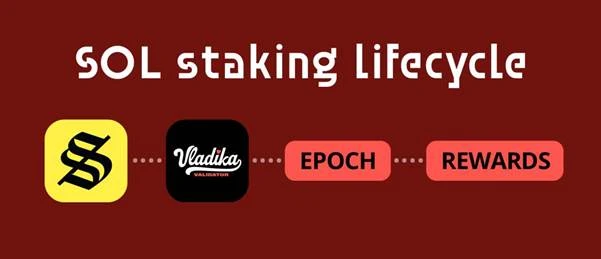
In other words, staking is not a transfer of ownership — it is a temporary assignment of role within the blockchain system.
Assigning a Validator Through Delegation
Once the staking account exists, your SOL is delegated to a chosen validator. This step determines who will represent your stake in Solana’s Proof-of-Stake mechanism.
Validators use delegated stake as voting weight when confirming blocks and maintaining network consensus. The more stake a validator accumulates, the more influence they have in the validation process.
This is where users indirectly contribute to the decentralization and stability of the blockchain. By choosing validators, stakers help distribute power across the network rather than concentrating it in a few hands.
Activation Phase and Epoch Timing
Stake does not become active instantly after delegation. Instead, Solana organizes all staking updates into time periods called epochs, each lasting roughly two days.
During the next epoch boundary, your delegated stake goes through an activation phase. Only after this transition does it begin contributing to consensus and validator voting power.
This delayed activation ensures smooth network operation, preventing sudden fluctuations in validator weight and maintaining stability across the system.
Validator Participation and Block Voting
Once activated, your delegated stake becomes part of the validator’s voting power. Validators continuously vote on blocks, confirming transactions and helping secure the blockchain.
Each correct vote generates what is known as vote credits. These credits form the foundation for calculating rewards at the end of every epoch.
At this stage, validator performance becomes crucial. Factors such as uptime, infrastructure stability, and consistency directly influence how many vote credits are earned — and therefore how much reward is distributed to delegators.
Reward Distribution and Yield Generation
Staking rewards on Solana primarily come from network inflation. At the end of each epoch, newly issued SOL is distributed among validators and their delegators based on performance.
Your share of rewards depends on how much stake you delegated and how efficiently your validator performed during that period.
Some validators also pass along additional earnings from transaction ordering value (MEV), which can further enhance overall yield.
Over time, these rewards are automatically added back into your staking balance, allowing your holdings to grow through compounding.
The Compounding Effect Over Time
One of the key advantages of staking is that rewards are not paid out separately by default — they are reinvested into your stake.
This means that with each epoch, your staking base gradually increases, and future rewards are calculated on a larger amount. Over time, this compounding effect can significantly increase total returns without requiring any manual action from the user.
For many long-term holders, this is one of the main reasons staking becomes a preferred strategy for passive participation in the Solana ecosystem.
Unstaking and the Cooling Period
When you decide to unstake, the process also follows Solana’s epoch structure. Your stake enters a deactivation phase, during which it gradually stops participating in validation.
This cooldown period typically lasts one epoch. Once completed, your SOL becomes fully liquid again and can be transferred or withdrawn without restrictions.
This mechanism ensures that changes in staking participation remain orderly and do not disrupt validator performance.
Why Validator Choice Still Matters
Even though staking is automated at the protocol level, the validator you select has a direct impact on your results.
Performance metrics such as uptime, voting efficiency, and commission rates all affect how much reward your stake generates over time. Choosing a reliable validator helps ensure consistent participation in the network and more stable returns.
This is where platforms like Vladika come into play, focusing on high-performance infrastructure and transparent reward distribution to support delegators.
A Practical Approach to Staking with Vladika
For users who want both simplicity and efficiency, staking through Vladika provides a streamlined experience built around performance and transparency.
The infrastructure is optimized for consistent validator uptime and fair reward distribution, allowing delegators to benefit from network inflation and additional reward streams without unnecessary complexity. Vladika’s approach focuses on making staking both accessible and predictable for long-term participants.
To better understand potential earnings before staking, users can also use a SOL Staking Calculator, which helps estimate rewards based on stake amount, validator performance, and network conditions.
At the same time, Vladika continues to maintain a strong focus on network reliability and decentralized participation, ensuring that delegated stake contributes meaningfully to the overall health of Solana.
Final Thoughts
Staking SOL is not just a passive earning mechanism — it is an active participation in the Solana consensus system. Behind every click lies a structured process involving staking accounts, validator delegation, epoch scheduling, reward distribution, and compounding mechanics.
Understanding these layers helps make staking more transparent and gives users better control over their long-term strategy.
See Also: CME Group Launches CFTC-Regulated Solana & XRP Options Market