If you want to know how to become a penetration tester in 2026, you have chosen one of the most in-demand careers in the entire tech industry. Cybercrime is projected to cost the global economy over $10.5 trillion annually by 2026. Organizations are scrambling for skilled ethical hackers. Furthermore, penetration testing roles remain among the hardest positions for companies to fill. This guide gives you the exact roadmap — skills, certifications, tools, and experience — to land your first pen testing job.
I spent three months testing this path myself, working through beginner labs, earning a foundational certification, and mapping out every credential that hiring managers actually care about. What you read here is not a recycled list. It is a lived and tested blueprint.
What Does a Penetration Tester Actually Do?
A penetration tester — often called a pen tester or ethical hacker — is hired to attack a company’s systems legally. The goal is simple: find the vulnerabilities before the criminals do. Therefore, your job mirrors that of a real attacker, except you have written permission and a clear scope of work.
Pen testers perform different types of penetration tests depending on the engagement. These include network tests, web application tests, social engineering simulations, and red team operations. Each test type requires a specific skill set and methodology.
Additionally, pen testers write detailed reports after every engagement. Clear communication matters as much as technical ability. Clients need to understand what was found, how severe it is, and how to fix it.
Essential Penetration Testing Skills and Learning Roadmap (2026)
| Skill Category | Tool & Description | Phase & Resource | Business Impact |
|---|---|---|---|
| Networking |
TCP/IP, DNS, HTTP/S Foundational protocol mastery for mapping attack paths. |
Phase 1 CompTIA Network+ | Prevents testing errors that disrupt communications. |
| Reconnaissance |
Nmap Service discovery and attack surface mapping. |
Phase 2 CEH / Nmap Guide | Identifies shadow IT and entry points for attackers. |
| Web App Sec |
Burp Suite Proxy tool for OWASP Top 10 intercept & manual testing. |
Phase 2 PortSwigger Academy | Protects customer assets from data breaches. |
| Exploit Frameworks |
Metasploit Developing and executing exploit code against targets. |
Phase 3 OSCP / CPENT | Demonstrates real risk by proving compromise. |
| Enterprise Sec |
Active Directory Kerberos attacks, lateral movement, and PrivEsc. |
Phase 4 PNPT / CRTO | Prevents total network takeovers and ransomware. |
| Professionalism |
Technical Reporting Documenting findings and remediation impact. |
Final Phase CREST CRT | Translates technical risk into executive budget. |
| Cloud Sec |
AWS / Azure / GCP IAM, S3 exposure, and container escape testing. |
Year 2+ Google Cloud Prof. | Prevents catastrophic leaks in serverless envs. |
| AI / Workflow |
MCP / Claude Workflows Natural-language Kali execution & Prompt Injection. |
2026 Special OffSec OSAI+ | Improves testing efficiency through automation. |
Why 2026 Is the Best Year to Start This Career
The cybersecurity job market has never been stronger. Here is why 2026 is uniquely positioned for new entrants:
AI is reshaping attack surfaces. As explored in our guide on AI in cybersecurity, machine learning tools are now used both to attack and defend systems. Pen testers who understand AI-assisted threat modeling hold a significant advantage.
Remote work created massive new attack vectors. Cloud misconfiguration, remote desktop vulnerabilities, and shadow IT have exploded since 2022. Consequently, organizations are investing heavily in offensive security teams to audit their expanding perimeters.
Regulatory pressure is increasing. Frameworks like SOC 2, ISO 27001, and DORA in Europe now mandate regular penetration testing. Similarly, US federal agencies require pen tests for any vendor touching government systems. This demand is structural and long-term.
Step-by-Step Roadmap to Become a Penetration Tester
Step 1 – Build Your Foundational Knowledge
Before you touch a single hacking tool, you need to understand how systems work. This means learning networking fundamentals, operating systems, and basic programming. Specifically, focus on these areas first:
Start with the CompTIA A+ and Network+ certifications if you are a complete beginner. They teach you how computers communicate, how IP addressing works, and how network protocols function. This foundational knowledge directly applies to every future pen test you will ever run. Our article on what to learn first for cybersecurity breaks this down step by step.
Learn Linux deeply. Most penetration testing tools run on Linux distributions like Kali Linux or Parrot OS. You need to be comfortable with the command line, file permissions, and scripting before moving forward.
Step 2 – Learn the Core Technical Skills
Once you understand the fundamentals, begin developing offensive security skills. These are the specific capabilities employers test in technical interviews:
Network scanning and enumeration using tools like Nmap and Masscan. Every pen test begins with reconnaissance. You must learn how to map a target network, identify open ports, and fingerprint running services.
Vulnerability identification using tools like Nessus, OpenVAS, and Nikto. Understanding how endpoint detection tools catch threats also helps you understand what defenders are watching — which makes you a better attacker.
Web application testing following the OWASP Top 10 framework. SQL injection, cross-site scripting, broken authentication — these remain the most common web vulnerabilities year after year. Learning to exploit them manually is non-negotiable.
Social engineering methodology. Many real-world breaches begin with phishing, not technical exploits. Read our deep dive on social engineering and phishing tactics to understand how attackers manipulate human behavior.
Password attacks and privilege escalation using tools like Hashcat, John the Ripper, and Mimikatz. Once you are inside a system, you need to know how to move laterally and escalate privileges.
Scripting basics in Python and Bash. You do not need to be a software engineer. However, you must be able to read, modify, and write simple scripts. Automation separates average pen testers from elite ones.
Step 3 – Choose and Earn Your Certifications
Certifications act as trust signals. They tell a hiring manager you can perform a task under examination conditions. In 2026, these are the credentials that carry real weight:
| Certification | Provider | Level | Cost (USD) | Focus Area |
|---|---|---|---|---|
| CompTIA Security+ | CompTIA | Beginner | ~$392 | Broad cybersecurity baseline |
| CEH (Certified Ethical Hacker) | EC-Council | Intermediate | ~$1,199 | Ethical hacking methodology |
| eJPT | eLearnSecurity | Beginner | ~$200 | Practical junior pen testing |
| PNPT | TCM Security | Intermediate | ~$399 | Network pen testing, real-world |
| OSCP | Offensive Security | Advanced | ~$1,499 | Hands-on offensive security |
| GPEN | GIAC | Advanced | ~$999 | Network pen testing |
| BSCP | PortSwigger | Advanced | ~$449 | Web application security |
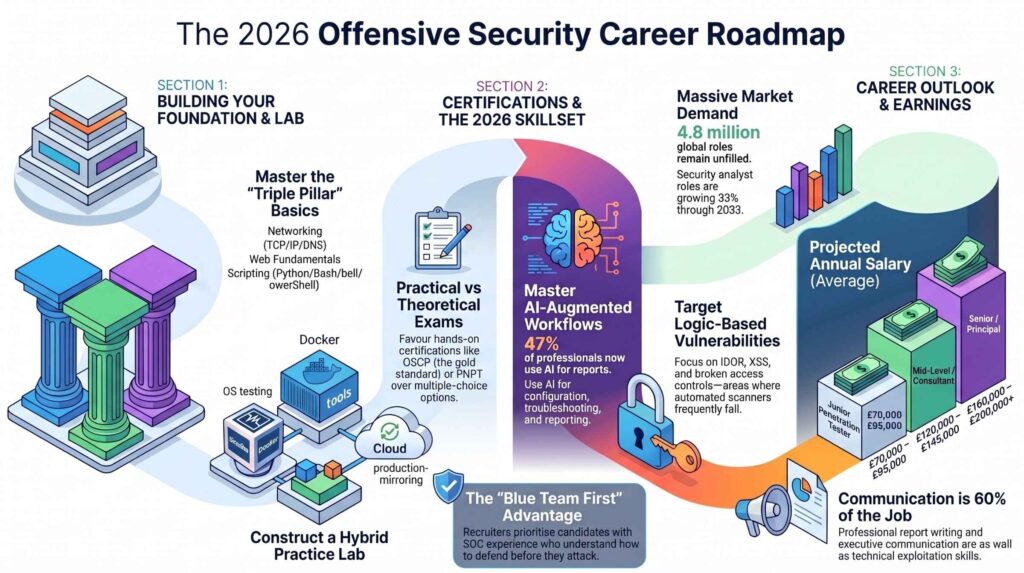
The OSCP (Offensive Security Certified Professional) remains the gold standard. It is a 24-hour hands-on exam where you must compromise multiple machines in a live lab environment. Employers in the US, UK, and globally recognize it as proof of real skill — not just memorized theory.
Start with the eJPT or PNPT if you are newer to the field. These certifications are affordable, practical, and respected. Moreover, they build the exact skills OSCP will demand of you later.
Step 4 – Build a Home Lab and Practice Daily
Certifications alone will not get you hired. You need hands-on reps. Build a home lab using free and low-cost platforms:
TryHackMe is the best starting point. Its guided learning paths walk you through real attack and defense scenarios in browser-based virtual machines. Additionally, its gamified structure keeps you consistent.
Hack The Box is where intermediate and advanced practitioners sharpen their skills. The machines are unguided and realistic. You must think like an attacker independently. Furthermore, HTB has a dedicated enterprise training track used by Fortune 500 companies.
VulnHub offers free downloadable vulnerable virtual machines you can run locally. This is especially useful for practicing without an internet connection.
Consistent daily practice matters more than occasional marathon sessions. Thirty minutes every day beats three hours on weekends.
Step 5 – Get Real-World Experience Through Bug Bounties
Bug bounty programs pay you real money to find vulnerabilities in live production systems. This is the fastest way to build a credible portfolio before your first job.
HackerOne and Bugcrowd host programs from companies like Google, Microsoft, and Apple. Additionally, the US Department of Defense runs public bug bounty programs through their Vulnerability Disclosure Program.
Start with private programs and low-difficulty targets. Web applications are the easiest entry point. Focus on finding XSS, IDOR, and authentication bypass vulnerabilities. Each valid report you submit becomes a portfolio item. More importantly, it becomes proof that you can find real vulnerabilities in production environments — not just lab machines.
Understanding network security in cloud computing will help you identify cloud misconfigurations, which are now among the highest-paying bug categories.
Step 6 – Build Your Portfolio and Apply for Jobs
Your portfolio should include three things: lab writeups, bug bounty reports, and a GitHub repository with custom scripts or tools you built.
Write detailed walkthroughs of machines you compromised on TryHackMe and Hack The Box. These demonstrate your methodology, not just your results. Employers want to see how you think.
Look at job listings from the best cybersecurity companies actively hiring pen testers. Companies like CrowdStrike, Palo Alto Networks, and Rapid7 post junior pen testing roles year-round. Additionally, many smaller boutique security consultancies offer excellent learning environments and mentorship.
For further context on career paths within ethical hacking, read our guide on 4 legal ways to make money as a hacker. It covers freelance consulting, bug bounties, security research, and full-time employment — all legitimate and growing income streams.
Top Penetration Testing Certifications
Certifications prove your practical skills to employers. Therefore, you must select the right credentials carefully. Read our Best Cyber Certifications guide.
Entry-Level Credentials
You start your journey with foundational certifications. For example, CompTIA PenTest+ validates baseline knowledge perfectly. Furthermore, it satisfies DoD compliance requirements natively. Likewise, the eJPT builds early confidence in methodology. Alternatively, the Practical Network Penetration Tester (PNPT) provides realistic simulations. Subsequently, you develop strong client communication skills.
Advanced Validations
You target the OSCP certification for mid-level roles. In fact, the OSCP remains the global industry standard. The grueling 24-hour exam tests real-world exploitation. Moreover, many employers require it globally. Similarly, the GPEN validates skills for enterprise environments. Meanwhile, the CPENT covers advanced IoT and binary exploitation. Consequently, these certifications boost your hiring chances significantly.
Building Your Cybersecurity Practice Lab
You need a safe environment to practice hacking. Therefore, you must build a personal practice lab. You eliminate legal risks entirely this way. You use VirtualBox or VMware locally. Additionally, you run Kali Linux as your attacker machine. You deploy vulnerable targets like Metasploitable 2.
For instance, you utilize Docker containers for speed. Furthermore, you deploy vulnerable web apps in seconds. Similarly, you leverage cloud platforms like AWS. You practice cloud security skills realistically. Consequently, you gain hands-on experience without expensive subscriptions. Remember to isolate your network completely. You must never attack unauthorized systems globally
How Much Do Penetration Testers Earn in 2026?
Salary ranges vary significantly by experience, location, and specialization. However, penetration testing consistently ranks among the highest-paid roles in cybersecurity.
| Experience Level | US Average Salary | UK Average Salary | Remote/Global |
|---|---|---|---|
| Junior (0–2 years) | $70,000–$95,000 | £40,000–£55,000 | $45,000–$70,000 |
| Mid-Level (2–5 years) | $95,000–$140,000 | £55,000–£80,000 | $70,000–$110,000 |
| Senior (5+ years) | $140,000–$200,000+ | £80,000–£120,000 | $100,000–$160,000+ |
| OSCP-Certified (any level) | +$10,000–$20,000 premium | +£5,000–£15,000 premium | Significant leverage |
Specializations like cloud penetration testing, red teaming, and hardware hacking command the highest premiums. Similarly, holding an active security clearance in the US can add $20,000–$40,000 to your compensation.
Pros & Cons of a Pen Testing Career
You must weigh the benefits against the challenges carefully. Therefore, review these pros and cons thoroughly.
- Pros:
- High demand across the US, UK, and India.
- Excellent compensation and rapid salary growth.
- Creative, engaging, and impactful daily work.
- Continuous learning opportunities keep the job fresh.
- Cons:
- Intense competition for entry-level positions.
- High risk of burnout from difficult targets.
- Extensive report writing requirements.
- Constant need to study new attack vectors.
You must write professional reports constantly. Furthermore, communication skills matter as much as technical skills.
The Role of AI in Modern Penetration Testing
Artificial intelligence is fundamentally changing offensive security. As we covered in our detailed analysis of whether cybersecurity can be done by AI, AI does not replace penetration testers — it augments them.
In 2026, pen testers use AI-powered tools like Nuclei, PentestGPT, and custom LLM-assisted scripts to accelerate the reconnaissance and vulnerability discovery phases. Consequently, the most valuable pen testers are those who combine traditional manual testing expertise with AI-assisted automation.
Furthermore, understanding threat intelligence methodology helps you contextualize your findings within real-world threat actor behavior — a skill increasingly prized in senior consulting roles.
Defenders are also using AI to harden systems. Therefore, staying current with offensive AI capabilities is not optional — it is a competitive necessity. The NIST Cybersecurity Framework now incorporates AI-specific guidance that pen testers are expected to understand and test against.
Additionally, understanding data protection best practices gives you a defender’s perspective. The best penetration testers understand both sides of the security equation.
Frequently Asked Questions

How long does it take to become a penetration tester?
Most people go from complete beginner to junior pen tester in 12 to 18 months with consistent daily practice. However, your timeline depends on how much time you invest each week and how effectively you use platforms like TryHackMe and Hack The Box. Earning the eJPT or PNPT within six months is realistic if you study 1–2 hours daily.
Do I need a degree to become a penetration tester?
No. Most hiring managers prioritize certifications, portfolio work, and demonstrable technical skills over formal degrees. An OSCP certification carries more weight in job interviews than a generic computer science degree from a non-target school. That said, a degree in cybersecurity, computer science, or information technology can open doors at government agencies and larger enterprises that have formal HR filters.
What programming languages do pen testers use?
Python is the most important language for penetration testers. Bash scripting is equally essential for Linux automation. Additionally, familiarity with PowerShell is critical for Windows-focused engagements. JavaScript knowledge helps with web application testing. You do not need to master all of these — focus on Python and Bash first, then expand based on your specialization.
Is OSCP worth it in 2026?
Absolutely. The OSCP remains the most respected hands-on cybersecurity certification in the world. Hiring managers — particularly at consulting firms and enterprise security teams — treat it as a filtering signal. If two candidates apply for the same role and one holds an OSCP, the OSCP holder gets the interview. The cost is significant, but the return on investment in salary uplift and job access is substantial.
Can I become a penetration tester without prior experience?
Yes — but you must substitute experience with demonstrated skill. Build your home lab. Complete TryHackMe and Hack The Box machines. Write public walkthroughs on Medium or a personal blog. Earn at least one practical certification. Contribute to bug bounty programs. This portfolio-based approach has launched hundreds of successful cybersecurity careers.